© 2005 All Rights Reserved. Do not distribute or repurpose this work without written permission from the copyright holder(s).
Printed from https://www.damninteresting.com/the-killer-lakes-of-cameroon/
On the night of 15 August 1984, a truck sagging with the weight of a dozen passengers trundled along a misty road in Cameroon, Africa. Although there had been no indication of a problem mere moments before, the vehicle suddenly sputtered and stalled. The driver turned the key, but the churning ignition was unable to reanimate the engine. Most of the Cameroonians clambered out of the vehicle to investigate, but two remained atop the truck. Within a few moments, each of the ten passengers who had stepped off the vehicle slumped to the ground. Within minutes, they were dead.
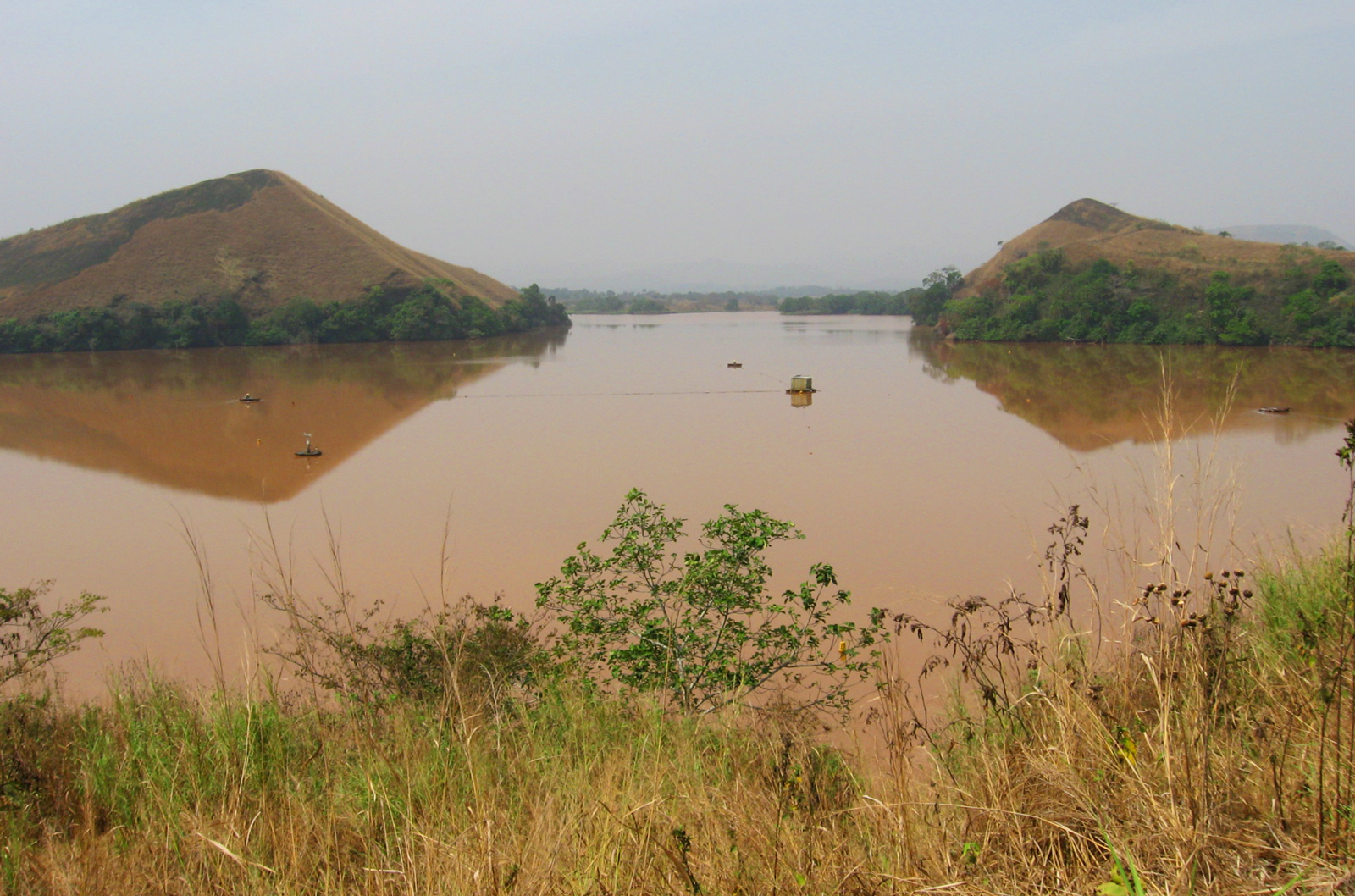
Those unfortunate travelers were not the only people in the area to die mysteriously that night. In the neighboring low-lying villages, twenty-seven other residents inexplicably passed away in their sleep, and an unspecified number of animals perished in the vicinity. Investigators were at a loss to explain the mass fatalities, wondering whether some exotic terrorist attack may have been to blame. Interviews with surviving villagers indicated that a distant explosion had been heard sometime after sunset, and that a light mist had appeared soon thereafter. A survey of the area found that nearby Lake Monoun had taken on a rusty tinge; but these clues were not consistent with any known weapon or natural disaster. It was not until about two years later that authorities ascertained that a mazuku, or “evil wind” had swept through the valleys of Cameroon that night, originating from the shores of the discolored lake. The water had not been tampered with by terrorists, however, nor was it the site of a volcanic eruption. The lake itself had exploded.
Although Lake Monoun resembles an ordinary lake to the naked eye, it is a rather abnormal body of water. Its basin is unusually deep and its walls are steep-sided, therefore surface winds are unable to produce enough turbulence to intermix the lake’s layers of water. For this reason, Lake Monoun’s cold lower stratum tends to remain undisturbed for decades—or even centuries. This stagnant lower layer is not particularly menacing on its own, but Monoun is also located directly above a volcanic vent which slowly leaks carbon dioxide (CO2) into the lake through the basin floor. In most lakes such gas bubbles would merely rise to the top, or dissolve in the water until natural intermixing cycles brought the CO2-bearing water nearer the surface. However the high pressure and cold temperature of the undisturbed bottom layer of Lake Monoun allowed the dissolved CO2 to linger and concentrate for years.
During that deadly evening in 1984, something stirred the water at the bottom of Lake Monoun—possibly seismic activity, a landslide, or rainfall. Whatever the cause, some of the supersaturated layer was nudged up from the bottom and allowed to mingle with warmer, lower-pressure waters. Although the temperature and pressure differences were only slight, the carbon dioxide crossed a critical threshold where it would no longer remain dissolved. One or more pockets of CO2 abruptly expanded into their gaseous state. These bubbles then acted as nucleation sites, causing surrounding water to give up its trapped gases as well. When these large bubbles raced towards the lake surface, their suction force drew more of the stagnant water up into the lower-pressure area, liberating even more CO2, and triggering a runaway chain-reaction.
Hundreds of thousands of tons of captive gas was belched from the depths of the lake in a matter of moments, blowing the top off the lake with tremendous force. The displaced water created a tsunami of sorts as the upper layers of the lake surged over the shores. The escaped mass—made up of carbon dioxide, carbon monoxide, and traces of hydrochloric acid—was heavier than the surrounding air, causing it to cling to the earth and slither down the valleys of Cameroon. The river of toxic gas was mostly invisible, with occasional patches of white mist. Almost everyone in its path was asphyxiated inside of a few minutes, although a handful fled to safety after watching their neighbors collapse, and a fortunate few were in elevated locations. Over the next few days, the lake gradually took on a red-brown tinge as the iron-rich water brought up from the deep was oxidized by the atmosphere.
The exploding-lake phenomenon, which had never been observed before then, came to be known as a limnic eruption. There are no surviving eyewitnesses of limnic eruptions, but we know that the effect is roughly analogous to an exploding soda-pop: when a sealed soda container is shaken, the turbulence causes some of the carbon dioxide in the solution to evaporate into short-lived bubbles stuck to imperfections on the inner walls of the can. These bubbles contain high pressure, but they remain small due to the internal pressure of the can. Opening the can while in this state releases that pressure, and the high pressure CO2 bubbles expand rapidly to equalize with the much lower ambient air pressure. To put it another way, a limnic eruption would look like someone threw a few billion MentosTM into a lake of Diet CokeTM.
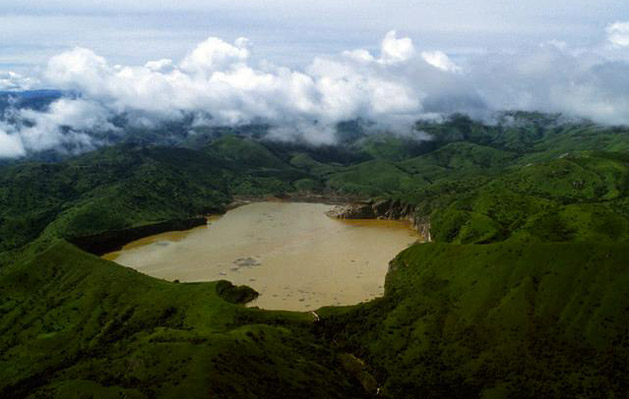
Almost exactly two years after the mysterious eruption, sometime during the night on 21 August 1986, another of Cameroon’s lakes exploded without warning. Lake Nyos, a body of water with features quite similar to Lake Monoun, let loose its own dense cloud of deadly gas. While the Monoun explosion was tragic, its death toll was dwarfed by the devastation of the second incident. Lake Nyos expelled over a million tons of gas—about a cubic kilometer—and the heavy cloud engulfed a populated valley. Villagers began to feel profoundly unwell, gasping for air but unable to get any oxygen. Some 4,000 people saved their own lives by fleeing from the valley, many of them suffering respiration problems that lingered for days. Of the 1,800 or so that were unable to escape the toxic cloud, only a few survived. One survivor was Joseph Nkwain from the village of Subum, who described his experience in a 1999 interview:
“I heard my daughter snoring in a terrible way, very abnormal . . . When crossing to my daughter’s bed . . . I collapsed and fell. I was there till nine o’clock in the morning . . . until a friend of mine came and knocked at my door . . . I was surprised to see that my trousers were red, had some stains like honey. . . .I opened the door . . . I wanted to speak, my breath would not come out . . . My daughter was already dead . . . I went into my daughter’s bed, thinking that she was still sleeping. I slept till it was 4:30 p.m. in the afternoon . . . on Friday. (Then) I managed to go over to my neighbors’ houses. They were all dead.”
The exact death toll was uncertain, but nearly every human and animal within a fifteen mile radius had perished. This included between 1,700 and 1,800 people, about 3,500 head of livestock, and massive amounts of wildlife. Investigators observed that Lake Nyos became reddish-brown over the following few days, just as Lake Monoun had done two years earlier. In addition, all vegetation on the lake’s shores had been mysteriously flattened, as if from an explosion.

Before the Lake Nyos eruption, scientists had still been uncertain regarding the cause of the 1984 deaths, but the devastation left by this second event clearly indicated that violent outgassings were to blame. The United States and several Western European countries sent emergency aid money, medical teams, and scientists to Cameroon to assist the victims and assess the cause of the catastrophe. Analysis of the lake confirmed that it was supersaturated with carbon dioxide, even in the aftermath of the eruption. In fact, the scientists estimated that the event had only released about 2% of the total dissolved gas in Lake Nyos. Meanwhile, the vents on the lake bottom are continuing to charge the water with CO2. Without intervention, the lake could erupt again in as little as a few years.
Since then, the much larger Lake Kivu in Rwanda has also identified as a likely site of periodic outgassings. Its waters contain a much higher than normal concentration of dissolved CO2 and methane, and fossil evidence indicates a massive biological die-off around the lake every 1,000 years or so. Due to the geography of Lake Kivu and the dense population along its shores, a limnic eruption there would likely result in the deaths of about two million people.
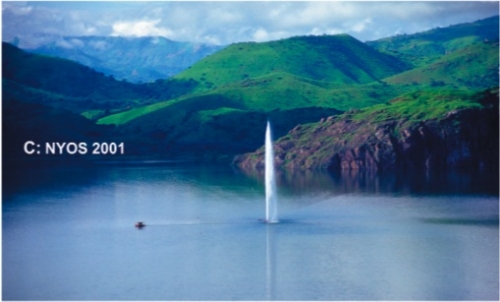
Today, sets of large polyethylene pipes constantly siphon the CO2-laden water from the bottoms of lakes Monoun and Nyos, producing carbonated geysers on each lake’s surface. However according to a 2005 report by the US Geological Survey, these scant few pipes are insufficient, and the treacherous lakes will not be rendered safe anytime soon. At present levels of gas concentration, a new eruption could occur at either lake, at any time, without warning.
In hopes of slowing down the progression of global warming, some scientists have suggested that the carbon dioxide pollution expelled by powerplants could be captured and stored before it enters the atmosphere; at which point it could be liquefied, and pumped deep in the ocean. There, they hope that the extreme pressure will prevent the CO2 from rising back to the surface. A researcher at the University of Michigan named Youxue Zhang has performed experiments that indicate that the minimum safe depth to prevent CO2 from rising to the surface would be about 800 meters down—about half a mile—but possibly as much as 3,000 meters, which is just short of two miles. According to Zhang, “Droplets injected to a depth of 800 meters will rise, but if they are small enough they should dissolve completely before reaching the liquid-gas transition depth—assuming everything works perfectly.”
Of course all of these data are based on computer models, and cannot possibly account for every possible variable, so one cannot have complete confidence in the results. Not does it account for what will happen if there are problems with the apparatus. Perhaps this does afford a way to dispose of some excess CO2 and slow down the progression of global warming, at least in the short-term. It may serve as a stop-gap while measures are taken to reduce overall carbon dioxide pollution. But trying to bury away our troubles in the oceans is certainly a problematic and irresponsible approach. Considering the deadly examples of lakes Nyos and Monoun, one hopes that humankind will not be foolish enough to adopt this solution in the long term.
A version of this article appeared in our actual, physical, paper book. You should buy a copy.
© 2005 All Rights Reserved. Do not distribute or repurpose this work without written permission from the copyright holder(s).
Printed from https://www.damninteresting.com/the-killer-lakes-of-cameroon/
Since you enjoyed our work enough to print it out, and read it clear to the end, would you consider donating a few dollars at https://www.damninteresting.com/donate ?
I think that we need to increase the use of nuclear power over fossil fuels. Radioactive waste is the only negative byproduct of nuclear power but if properly handled and stored will pose no harm to the environment.
MeasureMan said: “I think that we need to increase the use of nuclear power over fossil fuels. Radioactive waste is the only negative byproduct of nuclear power but if properly handled and stored will pose no harm to the environment.”
Unfortunately radioactive waste is more deadly to the environment and people. Its half life is somewhere in the neighbourhood of 10,000 years so that would be a grave mistake that I feel we shouldn’t make. Not only that but with all the burnt out fuel rods storage becomes a huge problem. When storage becomes a problem, terrorists would be able to get their hands on this stuff easier and voila you have dirty bombs in the making. Besides that, building and maintaining costs for nuclear power plants are prohibitive. Just look at Ontario, Canada and their nuclear power plant costs and you will get a better view of the picture I speak of. We here in Ontario are paying a debt retirement charge due to the huge expenditures of Ontario Hydro, now known as Hydro One. Most Ontarians don’t expect this charge to ever be removed from their bills.
I think the North American governments (Canada & USA) need to put much more money into hydrogen fuel research like hydrogen fuel cells. Well with a fossil fuel owning President, that money is not likely going to be available anytime soon.
As promising as hydrogen is, it still takes more energy to make than it releases in use. There is very promising research going on in the field of geneticly engineering plants to make hydrogen photosynthetically, but this is also in it’s infancy. Nuclear energy is viable, but it takes something like a decade to build a nuke plant so it’s not really a short term solution, plus there is the problem of all that nasty plutonium left over. To me the obvious answer has always been to get the waste off-planet, but there is always the specter of an aborted launch to worry about. Hence, another great use for the space elevator. If nuclear waste can be safely raised out of the gravity well and sent sunward all is flowers and butterflies.
What happened to solar energy? A whole big sun everyday and we can’t come up with something to capture its energy? ANYTHING that can be mass produced? I mean I know that they would have to have these giant ugly sun catching things. But that is only because they don’t want to go down that road and finally invent something that can be small, efficient, and run a city.
We need a Bill Gates for Energy. Then everyone can say how that person doesn’t have the best or most efficient Solar Energy Thingy; it was that other guys idea first. His Solar Energy Thingy genius was in marketing, bundling and stamping out the oil lamp Mom & Pop Stores and inhibiting new entrepreneurs by quickly throwing together a mimicky doo-hickey but in need of many patches but you are stuck with it because everyone already bought 1.0!
And then when we all have what we need we will become so addicted to it we won’t want to shut off any light on the roads, parks, individual houses and bad people will want to intrude and will be able to see into our homes at all times and throw rocks threw our “windows” (ahem) so then a whole new industry will pop up with rock deflecting shutters and, um, and … :::puff::tangent::puff:::
In a statistics class I completed recently, we studied the relationship between Global Warming and Carbon Dioxide and discovered the level of Carbon Dioxide has no linear relationship to temperature averages globally. The CO2 levels worldwide are not significantly high, at least as far as should pose any kind of danger, and although it is elevated relative to past readings, the global temperature has not risen with that rise.
By the way, CO2 is what plants eat. They excrete oxygen. More CO2 should mean an increase in plants, which will over time, net a decrease in CO2. It is designed to balance. Besides, man is not the chief producer of carbon dioxide. There are tons of insects, for example, per person. They inhale air using oxygen and exhale air with waste carbon dioxide.
I say we just use nuclear energy and put it on the moon, or maybe antarctica.
No one likes penguins anyway.
Semperloco said: “In a statistics class I completed recently, we studied the relationship between Global Warming and Carbon Dioxide and discovered the level of Carbon Dioxide has no linear relationship to temperature averages globally. The CO2 levels worldwide are not significantly high, at least as far as should pose any kind of danger, and although it is elevated relative to past readings, the global temperature has not risen with that rise.”
I’m sure your results were accurate based on the data you were provided with, but the real question is in the accuracy of the data itself. I’m no expert, but I believe things are far more complicated than just comparing CO2 vs Temperature.
Semperloco says: Besides, man is not the chief producer of carbon dioxide
Why would he need to be? Throwing off the balance by a really small amount (say a couple of percent) resulting in a temperature increase of a couple of degrees could potentially be disastrous.
Semperloco says: There are tons of insects, for example, per person
Our biomass has nothing to do with how much CO2 our industries produce.
Some day , someone will show me some science proving that global warming is anything more than a natural and cyclical event .
Since in a previous article we were talking about a “space elevator”, can’t we either attach a chimney to it and pump the carbon dioxide out to space, or load it up with nuclear waste and send it on a collision course with the sun?
PS – Oh, and hydrogen manufacture does not necessarily use more energy than it saves. Methanol and ethanol can easily be used in reformers that can be used to supply fuel cells and the like. You still get considerably more energy out than you needed to obtain your gas. I’m a fuel cell research engineer. I know these things.
JustAnotherName said: “… they don’t want to go down that road and finally invent something that can be small, efficient, and run a city. “
Or we don’t see enough promise in it. If you think something small and efficient can be built and will be powerfull enough to run a city, you should invent it. I’ll buy one.
http://www.nyos.lv/?l=2&m=1&c=8&p=1
“… , trigger mechanism of the limnological catastrophes, who be happened in CAMEROON on lake “MONOUN” in 1984 and on lake “NYOS” in 1986 , was switched on by influence of the atmospheric precipitations in 1983.
Limnological catastrophes on lake “MONOUN” in 1984 and on lake “NYOS” in 1986, were caused by the instantaneous ejections of the gaseous carbon dioxide from the sediment stratums under the lake’s bottom.
The Degassing the waters of the lakes “NYOS” and “MONOUN” can not prevent from the repetition in lakes “NYOS” and “MONOUN” of the limnological catastrophes, similar to the catastrophes of 1984 and of 1986 , in which the trigger mechanism was switched on by the influence of the atmospheric precipitations.
Under influence of the atmospheric precipitation the trigger mechanism of the the limnological catastrophes in the lake “Nyos” and the “Monoun” , in any time may to be switched on and in a certain time hereon will happen of the limnological catastrophes.”
http://www.nyos.lv/?l=2&m=1&c=&p=
THE DISASTROUS CONSEQUENCE OF THE REDUCTION INTO TWENTY METERS OF THE LEVEL OF THE WATER IN LAKE “NYOS” IN CAMEROON , WHICH ARE NOT TAKEN INTO ACCOUNT IN REPORT ABOUT ASSESSMENT OF THE DAM ON LAKE “NYOS” BY MISSION “Joint UNEP/OCHA Environment Unit”, WHO HAD VISITTED CAMEROON IN SEPTEMBER 2005.
The Reduction into 20 metres of the water level in the lake “Nyos” significantly magnifies probability of the mortal catastrophe in contrast with probability of the catastrophe in the natural conditions. The strengthening the existing dam (without reduction of the water level) on the lake “Nyos” does not magnify probability of the catastrophe.
Semperloco said: “By the way, CO2 is what plants eat. They excrete oxygen. More CO2 should mean an increase in plants, which will over time, net a decrease in CO2. It is designed to balance.”
Unfortunately we are destroying forests eg the Amazon far too quickly for balance to be restored.
Unfortunately radioactive waste is more deadly to the environment and people. Its half life is somewhere in the neighbourhood of 10,000 years so that would be a grave mistake that I feel we shouldn’t make.
Not exactly. After 10 years the waste from a nuclear reactor is 1/1000th as radioactive as when it is first removed from the reactor. After 500 years the waste is less radioactive than the naturally occuring uranium ore it was derived from.
It will continue to emit some radioactivity for thousands of years, but will be less radioactive than uranium veins in the Earth. Do you worry about the environmental threat posed by natural uranium buried in the Earth? No? Then why worry about this?
Not only that but with all the burnt out fuel rods storage becomes a huge problem. When storage becomes a problem, terrorists would be able to get their hands on this stuff easier and voila you have dirty bombs in the making.
Nuclear wastes stored in sealed casks two miles under a mountain on U.S. military land are far, far, FAR less likely to wind up in the hands of terrorists than wastes stored in on-site ponds, which is where all U.S. waste is currently stored.
Besides, there are hundreds of things in the world which terrorists can use to cause mass death and destruction, most being far easier to obtain than nuclear fuel rods. No one suggested permanently grounding the airline industry on 9/12!
Besides that, building and maintaining costs for nuclear power plants are prohibitive.
The only energy source cheaper than nuclear is coal. Plants may cost a lot to build, but their energy output is enormous. Costs could be reduced further by using modern technology to design one or two standardized, well tested, fail safe reactor cores, and using those designs across the U.S. or even the globe.
I think the North American governments (Canada & USA) need to put much more money into hydrogen fuel research like hydrogen fuel cells. Well with a fossil fuel owning President, that money is not likely going to be available anytime soon.
Hydrogen is not an energy source, it’s an energy transport, a battery of sorts. You have to use energy to make hydrogen because there are no pools of ready-made hydrogen in the world, unlike oil, gas, and coal.
To be completely honest, I cannot begin to understand why hydrogen is being considered as a gasoline replacement for cars. You would have to burn more fossil fuels, producing more CO2, to fuel a car fleet with hydrogen than if you just dumped gasoline in the things like we do now. Unless, of course, you use nuclear to fuel your hydrogen production. Which nobody in the U.S. wants to do thanks to irrational fears.
On top of that, hydrogen in an internal combustion engine (ICE) will produce water vapor as exhaust. What is water vapor? The primary greenhouse gas on Earth.
Hydrogen *fuel cells* would produce liquid water waste which could be easily collected, even used for drinking water. And a fuel cell stack is much more efficient than ICE. But you still have the problem of burning more fossil fuel to produce the hydrogen than if you just stuck the fossil fuel right in the fuel cell. If fuel cells are ever made cheap and reliable enough for the consumer, it will be trivial to design them to use a wide range of fuels.
What happened to solar energy? A whole big sun everyday and we can’t come up with something to capture its energy? ANYTHING that can be mass produced? I mean I know that they would have to have these giant ugly sun catching things. But that is only because they don’t want to go down that road and finally invent something that can be small, efficient, and run a city.
When you walk outside on a bright, warm, sunny day, does your face burn off? Does your metal watch or jewelry melt off? Do your clothes start on fire? No?
Now you understand why solar costs so much and requires “giant ugly sun catching things.” The total amount of solar energy hitting the entire globe may be massive, but the amount striking any square meter is pretty minor. That’s why you feel warmth on your face in the sunshine, and do not burst into flames.
Maybe someday we’ll have cheap “giant ugly sun catching things” that we can spread out across massive tracts of empty land to capture most of the energy we need. But they will always be giant. There’s no such thing as powering a city with a “small” solar panel.
Throwing off the balance by a really small amount (say a couple of percent) resulting in a temperature increase of a couple of degrees could potentially be disastrous.
Why are people so quick to think this? Really think about it for a moment. Most points on the Earth have swings of 50 degrees F or more between winter and summer. Do you honestly think a couple degrees difference will cause disaster? Why? What in Earth’s climate history would make you think this?
In terms of average temperature throughout the year, the Earth has been warmer than today, warmer than today plus a few degrees, several times within human history, to say nothing of prehistory. The Medieval Climate Optimum was warmer, and anyone who denies this with “hockey stick” graphs needs to explain farming in Greenland and wine exports from England during this time. The Roman warm period was even hotter than the Medieval period.
Nothing fell apart. Coastal cities which were around then as well as now didn’t flood. There was no massive collapse of the planet’s weather system or ecology. (And yes, both periods were global.)
In fact, humanity has historically done much better during the warm periods. I would guess life in general also does much better, with much greater biodiversity.
Don’t get me wrong, I would be uneasy if I thought man was the primary motivator of climate temperatures. But I still wouldn’t join the “do something NOW” Al Gore crowd in panic. Especially since the impact of additional CO2 drops rapidly as the window of wavelength absorption saturates.
But I’m not uneasy because I quite frankly don’t believe man is all that significant a contributor. The rise over the past century was a mere 0.6C. That’s not a lot, it’s not very fast, and it’s much less than would be predicted by the computer climate models being used to scare everyone about the 21st century.
dtaylor said a whole buncha stuff.
You are obviously familiar with the topic and I agree with much of what you’ve said. I would make two points you might consider:
1) While global temperatures are by no means at record highs, global atmospheric CO2 levels are well above their historic highs (according to recent ice cores, several hundred thousand years). Why does everyone do correlations between average temperatures and CO2 levels? This seems odd to me as why would you assume a 5 gigagigagigagram object would not have some lag time in its response to a forcing function? Back of the envelope I estimate a 100-year characteristic response time, but that’s highly simplified. I’m no expert on climate issues.
2) Rather than comparing fuel cells to on-the-road ICE’s, check out advanced engine technologies. My personal favorite is the HCCI (homogeneous charge compression ignition) engine. They have some difficult control problems, but their theoretical efficiencies are around the theoretical efficiencies of fuel cells.
Why does everyone do correlations between average temperatures and CO2 levels? This seems odd to me as why would you assume a 5 gigagigagigagram object would not have some lag time in its response to a forcing function?
Because the core process is not subject to a lag. If you double the amount of CO2 in the atmosphere tonight, it’s not going to take 100 years for that CO2 to begin absorbing additional radiation within its absorption window. It will happen when the sun rises tomorrow. And, assuming everything else remained precisely equal for comparison, it should be measurable in terms of air temperature immediately.
We’re not talking about warming a slow-to-respond body like the Antarctic ice cap, but air temperatures which vary dramatically based on the angle of the sun throughout the day.
Rather than comparing fuel cells to on-the-road ICE’s, check out advanced engine technologies. My personal favorite is the HCCI (homogeneous charge compression ignition) engine. They have some difficult control problems, but their theoretical efficiencies are around the theoretical efficiencies of fuel cells.
My guess, based on recent developments in Lion battery technology, is that pure EVs will ultimately replace the fossil fuel powered ICE. An EV has a lot of advantages, not the least of which is that it’s trivial to build once you’ve solved the battery performance problem.
But yes, there’s a large portfolio of advanced engine concepts out there, some of which are very interesting.
dtaylor said: “Because the core process is not subject to a lag.”
But there should be a lag in water vapor, which makes up a much more significant chunk of greenhouse gas change, and I’d think primary variable for water vapor concentration would be ocean temperatures. Maybe I should actually learn something about climate modeling. Regardless, going that far out of the known CO2 envelope still gives me the heebie-jeebies.
dtaylor said: “My guess, based on recent developments in Lion battery technology, is that pure EVs will ultimately replace the fossil fuel powered ICE. An EV has a lot of advantages, not the least of which is that it’s trivial to build once you’ve solved the battery performance problem.
But batteries will never have the power/weight ratio that ICEs have. Using a well designed ICE as a generator in an electric car seems a lot more economical assuming some environmentally benign fuel source, which is a whole other can of worms and gets back to EV’s…
May the best technology win.
global warming cause by humans is a myth
do you know that the magentic field of the earth is decreasing?
it is expected that a pole reversal may be under way.
we get 35,000 times the amount of energy we generate from the sun
the decrease in the magnetic field allows more of the particle radiation to reach the Earth, from the sun
what effect does that have?
also, methane, which is a natural product of the Earth and animals such as cows and termites is 20 more of an issue that carbon dioxide. termits are the number 2 producer of methane.
also, what caused all those different ice ages?
what caused them to end?
i doubt is was cave men calling Geico.
did you know that we are still warming up from the Little Ice Age of 800 years ago?
did you know that people live in GreenLand back then and grew grapes but had to leave as it got colder?
wargammer said: “global warming cause by humans is a myth…
….methane, which is a natural product of the Earth and animals such as cows and termites is 20 more of an issue that carbon dioxide. termits are the number 2 producer of methane.”
Just a point but havn’t you kind of proven yourself wrong there? Last time I checked we were the ones breeding the cows?
Besides arguments over whether we are or are not having a direct effect on global warming are pointless. It is happening and we do need to do something about it. We are lurching to a point where there simply wont be enough agricultural land to support the population. For example, already vast areas of America are becoming rapidly desertified and the main agricultural area of northern Australia is suffering a six year drought.
Unfortunately, wargammer your idea that the earth is in a natural warming cycle is unfounded. Most scientists (ie: ones not paid by fossil fuels companies) agree that based on the evidence from Ice cores, ancient peat cores and other sources that prior to about 200 years ago(up to the industrial revolution. Coincidence?) the earth was actually on a cooloing curve. Since that period the earth has been warming, this in itself is not a problem (sea levels may rise and drown a few cities but oh well!), it is the speed at which the temperature has risen. Normal temperature fluctuations are over thousands or hundreds of thousands of years allowing ecological systems the time to adapt 2 or 300 years is just two fast which is leading to an ecological crash and a mass extinction of species.
Most of those species will be ones we don’t even notice or need, some like the polar bear we will miss because of its asthetic value others like maize, wheat and rice we will definately miss.
This is the scary fact the majority of the human population survives on a diet based on three grains. Those grains are perfectly acclimitised to grow in certain climate conditions. Those conditions have been pretty constant for most of the time since we switched to agriculture from a hunter gatherer societies. In fact it is clearly recorded that most times of mass famine are at times of climate fluctuations i.e. after the Thera and Krakatoa eruptions. We are rapidly lurching towards a climate where there wont be enough land left to support the sort of agriculture we currently use, a climate where the three main grains will not grow.
Climate change is happening we need to do something about it.
The whole “Man is responsible for Global Warming” is really getting old. I guess those Gas Guzzling, energy inefficient Mars Rovers are the cause of Mars getting warmer. According to a September 20th NASA news release, “for three Mars summers in a row, deposits of frozen carbon dioxide near Mars’ south pole have shrunk from the previous year’s size, suggesting a climate change in progress.” Since one year on Mars is approximately two years on Earth, that equals a warming trend on Mars for the past six Earth years.
Also according to Sallie Baliunas, chair of the Science Advisory Board at the George C. Marshall Institute, said, “Pluto, like Mars, is also undergoing warming.” They have observed a steady decrease in Pluto’s polar caps. So there are at least three planets in this Solar System undergoing basically the same changes.
Lets not forget that they have observed an increase in Solar Activity. Otherwise the sun has been getting warmer.
If we are to believe Al Gore, all those incandescence light bulbs have cause Global Warming on Earth, Mars, Pluto, and even the Sun. Alas, man’s influence on the very fabric of space should be questioned. Or maybe it’s a government conspiracy within the Bush Administration looking for ways to control all the oil on Earth.
Anyone have a blueprint on how to construct a tin-foil hat?
Don’t get me wrong. Man is partially at fault. But the fossil record does show a cycle of warming trends vs. cooling trends. The climate is changing and we need to be more observant of this fact.
In reply to Radiatidon I dont deny, that natural cycles do have a part to play in global warming on this planet. There is an argument that increased solar activity over the past few years has played a part in the most recent effects. But it does not change the fact that the temperature has been rapidly increasing on this palnet for much longer than that, in fact the natural cycles are now just exacerbating an effect that we were already having. Global Warming is down to a number of factors, deforestation increase in CO2, methane and other greenhouse gas emmisions along with many other natural and non natural triggers. But isnt the logical argument to stop our own triggers to slow down the overall effects, as they the ones that we have control over?
As for your other point I feel the new Iraqi “fair trade” oil agreement and the rebuilding contracts probably show the true motives for the war. By the way there is quite a bit of the Black stuff under Iran, or so I hear. Maybe I need to get one of those tin foil hats? or just a tin helmet and a bomb shelter because I live right next to the North Sea Oil field!!!
Besides arguments over whether we are or are not having a direct effect on global warming are pointless. It is happening and we do need to do something about it.
If we’re not the direct cause, what makes you think we can do anything about it? :-)
We are lurching to a point where there simply wont be enough agricultural land to support the population. For example, already vast areas of America are becoming rapidly desertified and the main agricultural area of northern Australia is suffering a six year drought.
I can’t speak to Australia, but I’m unaware of any “vast areas of America” becoming “rapidly desertified.”
We regularly sell farm land for housing development because it’s so cheap. It’s so cheap because we don’t need any where near the farm land we have to produce all the food we need and export.
Most scientists (ie: ones not paid by fossil fuels companies)
Don’t appeal to logical fallacies.
agree that based on the evidence from Ice cores, ancient peat cores and other sources that prior to about 200 years ago(up to the industrial revolution. Coincidence?) the earth was actually on a cooloing curve.
Look up the Roman and Medieval warm periods.
It may be true that the curve of Earth’s climate, if measured from the beginning, is downward. But that’s not saying much because the Earth was pretty darn warm in prehistory. You don’t think T-Rex got that big in cold weather, do you?
Speaking in terms of recent history, we have cycles. And we may very well be on the upswing of a natural cycle. It certainly coincides with solar cycles.
Since that period the earth has been warming, this in itself is not a problem (sea levels may rise and drown a few cities but oh well!), it is the speed at which the temperature has risen. Normal temperature fluctuations are over thousands or hundreds of thousands of years allowing ecological systems the time to adapt 2 or 300 years is just two fast which is leading to an ecological crash and a mass extinction of species.
Not true at all. The rise of the Medieval warm period was within a couple centuries, and the shift to the little ice age may have been within one. Both swings were larger than the 0.6C rise we’ve observed in the past 130 years. There’s nothing to suggest 0.6C over that time period is abnormal. 1880 to 1940 saw a larger shift, first down and then up, than the overall shift for the century. Man wasn’t producing enough CO2 at the time to be the primary cause of that fluctuation, leaving nature as the cause.
BTW, statements like yours imply that there has been a continual, rapid rise for the past century. That is simply not the case in the global temperature records. Most of the warming of the 20th century predates the massive ramp up in CO2 output that occured during and following WWII. The period following WWII saw significant cooling. It wasn’t until the 80’s that temperatures ticked up again.
As to an “ecological crash” and “mass extinction of species”, I’ve read a lot of theories and a lot of guesstimates, but little hard evidence that extinction rates are high. The guesstimates are just that, pretty wild numbers based on very sketchy assumptions. I would expect extinction rates to be a little higher than “normal” at this time because of man’s growth. But I can’t see any reason to expect an “ecological crash” because of a 0.6C rise in global temperatures. Earth is still much cooler today than during the last warm period. Is there any evidence of mass extinction in fossils dating from 1000 AD? None that I know of.
Most of those species will be ones we don’t even notice or need, some like the polar bear we will miss because of its asthetic value others like maize, wheat and rice we will definately miss.
Oh please. None of these things are in danger.
Those grains are perfectly acclimitised to grow in certain climate conditions. Those conditions have been pretty constant for most of the time since we switched to agriculture from a hunter gatherer societies.
No, those conditions have not been constant. Earth has been warmer and cooler than today many times in the past…what…10,000 years.
In fact it is clearly recorded that most times of mass famine are at times of climate fluctuations i.e. after the Thera and Krakatoa eruptions.
Most times of mass famine occur during climate fluctuation downwards. Not up. Compare the Medieval Warm Period to the Little Ice Age. Was there even one famine of note during the Medieval Warm Period? There were plenty during the Little Ice Age.
We are rapidly lurching towards a climate where there wont be enough land left to support the sort of agriculture we currently use, a climate where the three main grains will not grow.
A warmer Earth leads to more arable land, not less. It also leads to longer growing seasons. On top of that, it is a well documented fact that increasing atmospheric CO2 has benefitted both farming and forest growth. Plants do much better with higher CO2 concentrations.
At the most a continued rise in temperature would change the latitudes at which these three grains thrived. Not where they could be grown, just simply where the greatest yields would be found. The total amount of land on which they could be grown would increase on a warmer Earth.
Arcangel said: “Unfortunately radioactive waste is more deadly to the environment and people.”
Not true. There are about 6,150 deaths per year on average due to coal mining accidents in China alone (based on 2000-2005 statistics.) That number doesn’t include the people who died due to lung or other problems caused by long-term exposure during the mining process or the deaths in all of the other countries where coal mining occurs due to pollution.
Furthermore, it only takes 1 tonne of uranium fuel to equal 120,000 – 350,000 tonnes of coal, meaning even if it is more dangerous to mine, it still takes hundreds of thousands of times less of it to produce an equal amount of power. See:
NOVA Science in the News: Prospect or suspect – uranium mining in Australia
http://www.science.org.au/nova/002/002key.htm
Even the Chernobyl accident has only claimed 56 lives since it occurred in 1986, which is less than the average number of people who die in Chinese coal mining accidents every four days. While there are various potential dangers with nuclear power, they are minor compared to the actual deaths we see every day due to other power sources.
Semperloco said: “In a statistics class I completed recently, we studied the relationship between Global Warming and Carbon Dioxide and discovered the level of Carbon Dioxide has no linear relationship to temperature averages globally.”
Were your statistics long term or just over the last 200 or less years? If it’s the former then I can understand how you could have come to that conclusion, however the short term data shows a strong correlation between the two. There are actually many factors, and CO2 is just one of them, so looking at CO2 alone is somewhat misleading and will give you a weaker correlation. However, when included in with all of the factors a strong and predictable correlation appears. (A graph showing the various factors can be seen here.)
Semperloco said: “The CO2 levels worldwide are not significantly high, at least as far as should pose any kind of danger, and although it is elevated relative to past readings, the global temperature has not risen with that rise.”
Climatologists disagree. It only needs to be an increase over the previous levels to have an effect, and any increase in greenhouse gasses means an increase in global temperatures. And need I point out that it’s much higher than it’s been in over 400,000 years!? (see here) Also, i’m not sure what you mean by “significantly high,” but as stated before, CO2 is just one of several factors, and when included with other factors it does account for the change in average global temperature. Remove it from the equations and they don’t work. See:
Wikipedia: Attribution of recent climate change
http://en.wikipedia.org/wiki/Attribution_of_recent_climate_change
Semperloco said: “By the way, CO2 is what plants eat. They excrete oxygen. More CO2 should mean an increase in plants, which will over time, net a decrease in CO2. It is designed to balance.”
First of all, it’s not “designed” at all, it’s “evolved,” and evolution doesn’t occur in anticipation of events, it occurs in response to them. Thus, over time organisms may evolve to handle a change in CO2 levels, but one should not confuse that for a built-in balance mechanism.
Second of all, just because CO2 increases doesn’t mean that plants or other photosynthesizing organisms increase. That’s like saying that if there was more oxygen then that would mean an increase in animals. It just ain’t so! Sure, more CO2 means plants grow faster, but the ratio of increase in CO2 levels to plant growth isn’t 1 to 1. A 300% higher levels of CO2 only means up to 50% greater plant growth rates. (see here)
Semperloco said: “Besides, man is not the chief producer of carbon dioxide. There are tons of insects, for example, per person. They inhale air using oxygen and exhale air with waste carbon dioxide.”
Irrelevant. The argument isn’t that there are too many humans breathing, it’s that industrial processes have greatly increased the amount of greenhouse gasses (including CO2) in the atmosphere, which have contributed significantly to causing the current climate change.
Radiatidon said: “The whole “Man is responsible for Global Warming” is really getting old. I guess those Gas Guzzling, energy inefficient Mars Rovers are the cause of Mars getting warmer. “
That’s a classic error in logic. Just because A causes B in one situation doesn’t mean that A is the only possible cause of B in all situations. Just because man isn’t responsible for warming on Mars doesn’t mean that man isn’t responsible for warming on Earth.
Radiatidon said: “Also according to Sallie Baliunas, chair of the Science Advisory Board at the George C. Marshall Institute, said, “Pluto, like Mars, is also undergoing warming.” They have observed a steady decrease in Pluto’s polar caps.”
Nice selective quoting there, you left out the part where Baliunas also said that the cause of the warming is “likely not the sun but long-term processes on Mars and Pluto”. Your source disagrees with you. (see here)
Radiatidon said: “So there are at least three planets in this Solar System undergoing basically the same changes.”
Similar changes in one respect, but that does not mean that they all have the same cause. The tires on three different cars may go flat, but that doesn’t mean that they all went flat for the same reason.
Radiatidon said: “Lets not forget that they have observed an increase in Solar Activity. Otherwise the sun has been getting warmer.”
No, the sun is the same temperature. I assume you meant that it was putting out more solar radiation, however the sun has actually been putting out less radiation since 2002. Solar radiation follows a roughly 11 year cycle (see here), and currently it’s at the bottom of a downward trend, not on an upward one.
Radiatidon said: “If we are to believe Al Gore, all those incandescence light bulbs have cause Global Warming on Earth, Mars, Pluto, and even the Sun.”
Nice straw man, however Gore has proposed no such nonsense. You’re the one jumping to that nutball conclusion, not him.
Radiatidon said: “Don’t get me wrong. Man is partially at fault. But the fossil record does show a cycle of warming trends vs. cooling trends. The climate is changing and we need to be more observant of this fact.”
We’re quite observant of that fact, and that’s how we know this trend is different from the ones in the past. Again, you’re assuming that one effect only has one possible cause, thus the cause in the past must be the same as the cause today. That’s poor logic and the facts simply don’t support it.
Radiatidon said: “Also according to Sallie Baliunas, chair of the Science Advisory Board at the George C. Marshall Institute, said, “Pluto, like Mars, is also undergoing warming.” They have observed a steady decrease in Pluto’s polar caps.”
HiEv said:”Nice selective quoting there, you left out the part where Baliunas also said that the cause of the warming is “likely not the sun but long-term processes on Mars and Pluto”. Your source disagrees with you. (see here)”
Gee it seems you are at fault with the same “selective quoting” as Radiatidon. In reading the article you linked to it actually seems to support Radiatidon.
Source said:”However, Baliunas speculated it is “likely not the sun but long-term processes on Mars and Pluto” causing the warming. However, until more information is gathered, Baliunas said, it is difficult to know for sure.”
This quote from the article says “Speculated”. Now the definition of speculation is: A guess. A hypothesis that has been formed by conjecturing with little or no hard evidence. (source Princetion.)
Radiatidon said: “So there are at least three planets in this Solar System undergoing basically the same changes.”
HiEv said:”Similar changes in one respect, but that does not mean that they all have the same cause. The tires on three different cars may go flat, but that doesn’t mean that they all went flat for the same reason.”
True, yet when my last home was being built I suffered three flat tires due to “construction nails” I picked up at the site. Each flat may have been caused by a different nail yet I had picked them all up at the same location.
Radiatidon said: “Lets not forget that they have observed an increase in Solar Activity. Otherwise the sun has been getting warmer.”
HiEv said:”No, the sun is the same temperature. I assume you meant that it was putting out more solar radiation, however the sun has actually been putting out less radiation since 2002. Solar radiation follows a roughly 11 year cycle (see here), and currently it’s at the bottom of a downward trend, not on an upward one.”
Yet that same article you linked to states that there is a possible solar link to global warming.
Radiatidon said: “If we are to believe Al Gore, all those incandescence light bulbs have cause Global Warming on Earth, Mars, Pluto, and even the Sun.”
HiEv said: “Nice straw man, however Gore has proposed no such nonsense. You’re the one jumping to that nutball conclusion, not him.”
LOL oh come on, don’t you understand sarcasm. Radiatidon was trying to be funny here. Really now. Al Gore has stated that light bulb manufacture and usage contributes to environmental pollution, which in turn contributes to global warming. He suggests that we all go to florescence lighting to reduce industrial pollution and its impact on the environment. Um, does he not realize that florescence lights require mercury to operate?
Personally I’m still on the sidelines here. Neither camp has fully explained to my satisfaction as to who the main culprit is. I do agree we need to do more to correct our current disregard for the environment though.
HiEv said: “… Similar changes in one respect, but that does not mean that they all have the same cause. The tires on three different cars may go flat, but that doesn’t mean that they all went flat for the same reason. …”
So, if you wake up in the morning, and you have flat tires, and your neighbors have flat tires, you will attribute the flats to different causes???
Semperloco said: “The CO2 levels worldwide are not significantly high, at least as far as should pose any kind of danger, and although it is elevated relative to past readings, the global temperature has not risen with that rise.”
Climatologists disagree. It only needs to be an increase over the previous levels to have an effect, and any increase in greenhouse gasses means an increase in global temperatures.
The temperatures have not consistently risen with the rise in CO2, and that’s not up for debate among climatologists because it’s a simple matter of laying one graph on top of the other. 20th century temperatures cycled, with a very clear and dramatic cooling period. (Which, btw, had the environmental movement in the late 70’s convinced that pollution was going to trigger a new ice age. Their opinion changed when the temperatures cycled back up in the 80’s.) 20th century CO2 measurements did not cycle or drop. Every year we added CO2 to the atmosphere, and every year the readings went up.
At the very least this disproves the notion that any increase in greenhouse gases automatically means an increase in global temperature. Global temperature is the result of many factors, some of which eclipse the total greenhouse effect of CO2 by several orders of magnitude.
Second of all, just because CO2 increases doesn’t mean that plants or other photosynthesizing organisms increase. That’s like saying that if there was more oxygen then that would mean an increase in animals. It just ain’t so!
Plants grow faster, larger, using less water, and with more resistance to stress factors with increases in CO2. We can, by comparing historical photographs, clearly see increases in growth across the planet. We’re pretty darn sure that the elevated levels of CO2 have increased vegetation and crop yields.
Sure, more CO2 means plants grow faster, but the ratio of increase in CO2 levels to plant growth isn’t 1 to 1. A 300% higher levels of CO2 only means up to 50% greater plant growth rates.
Likewise, more CO2 does not mean more greenhouse effect in anything like a 1-to-1 fashion. As the absorption window of CO2, which overlaps water vapor, becomes saturated, the impact decreases dramatically. Ignoring secondary factors for a moment, and assuming that the 0.6C rise of the 20th century was entirely due to man (the U.N. itself disputes this and only attributes a fraction of that rise to man), to raise temperatures by another 0.6C would require releasing 10x the CO2 in the 21st century.
Cesium said: “Gee it seems you are at fault with the same “selective quoting” as Radiatidon. In reading the article you linked to it actually seems to support Radiatidon.”
Just because I didn’t quote the whole article doesn’t mean I was using selective quoting. At least I linked to a source so you could read the whole article. Radiation didn’t do that and he quoted less than I did.
More importantly, the article doesn’t act actually support Radiatidon’s point. It just says that 10-30% of climate change may be attributed to increases in solar output. Well no duh! It’s that other 70-90% that’s mostly caused by man that needs to be dealt with. Solar output is a part of the equation, sure, nobody has said that it wasn’t, but it’s only a small portion of what’s causing this change.
Cesium said: “This quote from the article says “Speculated”. Now the definition of speculation is: A guess. A hypothesis that has been formed by conjecturing with little or no hard evidence. (source Princetion.)”
Neat. But you overlook the point that it is the author of the article who uses the word “speculated,” not Dr. Baliunas. The article appeared rather slanted in a way not supported by the evidence, IMHO.
Cesium said: “True, yet when my last home was being built I suffered three flat tires due to “construction nails” I picked up at the site. Each flat may have been caused by a different nail yet I had picked them all up at the same location.”
And…? Just because that happened in your one case then we should assume that’s always the case? What if you had checked more closely and found that one of the nails that caused one of the flats wasn’t a type that was used at the construction site? In fact, it was a kind of nail that you knew was used elsewhere. In that case it would be unreasonable to assume that all three nails came from the same place. That’s similar to what we’re seeing here. Some people are jumping to the conclusion that all three “nails” come from the same source because we see a similar effects. However, on closer study we see that the effects on Earth mostly come from another source, man.
Cesium said: “Yet that same article you linked to states that there is a possible solar link to global warming.”
No, there’s a clear link, it’s just a minimal one on Earth. The NASA report on Mars was from 1999 to 2005, and the solar cycle peaked around 2003, so that explains what solar output increases they were referring to there.
Cesium said: “LOL oh come on, don’t you understand sarcasm. Radiatidon was trying to be funny here. Really now. “
That may have been an attempt at sarcasm, but it was based on a distortion of the facts, and that’s the part I was disputing.
Cesium said: “Al Gore has stated that light bulb manufacture and usage contributes to environmental pollution, which in turn contributes to global warming. He suggests that we all go to florescence lighting to reduce industrial pollution and its impact on the environment. Um, does he not realize that florescence lights require mercury to operate?”
I’m sure he does realize that, but you’ve totally missed the point of his real argument. Gore’s main complaint against the incandescent light bulb is not pollution during production/disposal, but its inefficiency, which means wasted energy, which means more unnecessary pollution created by power plants. Not only that, but compact fluorescent light bulbs last longer than incandescent light bulbs. Also, they have capped the amount of mercury in compact fluorescent lights. And do you realize that burning coal also releases mercury into the environment? If the bulbs are properly disposed of the mercury and other materials can be recycled. So, between the longer life and the reduced pollution from the power plants, the overall pollution is less when using compact fluorescent lights, not more. (see here and here)
Cesium said: “Personally I’m still on the sidelines here. Neither camp has fully explained to my satisfaction as to who the main culprit is. I do agree we need to do more to correct our current disregard for the environment though.”
If you’re looking for a simple answer then you’ll never be convinced because the science isn’t simple. I say, forget the FUD spread by people who aren’t interested in the science when it doesn’t suit them, and pay attention to what the majority of the scientists in this area say. They have a far better understanding of this topic than we do, and they’re in strong agreement about many points regarding global warming. See here for starters:
Wikipedia: Scientific opinion on climate change
http://en.wikipedia.org/wiki/Scientific_opinion_on_climate_change
Cesium said: “So, if you wake up in the morning, and you have flat tires, and your neighbors have flat tires, you will attribute the flats to different causes???”
If my tires started going flat two months ago and theirs went flat last week, yes, I’d say there’s a good chance it’s different causes. In fact, it would be silly to attribute them to the same cause without good reason. Think about it this way, what if I rewrite your question like this: “So, if you wake up in the morning, and you have a dirty car, and your neighbors have a dirty car, you will attribute the dirtiness to different causes???” See? Both cars may be dirty, but they could be dirty for entirely different reasons. They might be dirty for the same reasons, but it’s illogical to simply assume that is the case, especially when if you examine the cases carefully you see there are differences between them.
If you’re looking for a simple answer then you’ll never be convinced because the science isn’t simple. I say, forget the FUD spread by people who aren’t interested in the science when it doesn’t suit them, and pay attention to what the majority of the scientists in this area say.
Science is NOT a democracy. Scientific theories are NOT established by vote.
No global climate model can accurately predict the climate today given historical data. They drift too warm or too cool, and generally just royally screw up what is happening where. Therefore no climate model passes the test of the scientific method. They’re useful for learning and playing “what if” scenarios, but only to a point. We simply do not fully understand the Earth’s atmosphere, therefore we are not in a position to be adamant about a particular theory or model, or a specific prediction.
I’m sorry, but I cannot look at the gaping holes which remain in climate science, the history of Earth’s climate with its many ups and downs, and the 0.6C rise of the 20th century, and get any where near excited.
If you’re looking for a simple answer then you’ll never be convinced because the science isn’t simple. I say, forget the FUD spread by people who aren’t interested in the science when it doesn’t suit them, and pay attention to what the majority of the scientists in this area say. They have a far better understanding of this topic than we do, and they’re in strong agreement about many points regarding global warming. See here for starters:
Read and consider Michael Crichton’s speech: http://www.crichton-official.com/speeches/speeches_quote04.html
Two quotes:
Let’s be clear: the work of science has nothing whatever to do with consensus. Consensus is the business of politics. Science, on the contrary, requires only one investigator who happens to be right, which means that he or she has results that are verifiable by reference to the real world. In science consensus is irrelevant. What is relevant is reproducible results. The greatest scientists in history are great precisely because they broke with the consensus. There is no such thing as consensus science. If it’s consensus, it isn’t science. If it’s science, it isn’t consensus. Period.
Finally, I would remind you to notice where the claim of consensus is invoked. Consensus is invoked only in situations where the science is not solid enough. Nobody says the consensus of scientists agrees that E=mc2. Nobody says the consensus is that the sun is 93 million miles away. It would never occur to anyone to speak that way.
dtaylor said: “The temperatures have not consistently risen with the rise in CO2, and that’s not up for debate among climatologists because it’s a simple matter of laying one graph on top of the other.”
Correct, but that is because, as I said before, CO2 levels are just part of the equation. However, CO2 levels are an essential part of explaining/predicting climate change. All factors would be rejected by the method you have described if you looked at them individually, which shows the flaw in that argument. This is why climatologists look at all factors together.
dtaylor said: “At the very least this disproves the notion that any increase in greenhouse gases automatically means an increase in global temperature. Global temperature is the result of many factors, some of which eclipse the total greenhouse effect of CO2 by several orders of magnitude.”
Almost exactly right, however greenhouse gasses, which includes CO2 as one factor, is the primary cause of global warming (see here). Now, I agree that some greenhouse gasses are more powerful greenhouse gasses than CO2 by mass, however CO2 is far more common, thus has a greater overall effect than any other source (see here). Because CO2 is such a major factor, both in the amount it has changed and the effect it has, many discussions revolve around CO2 levels, but it is still just one factor among several.
dtaylor said: “Likewise, more CO2 does not mean more greenhouse effect in anything like a 1-to-1 fashion. As the absorption window of CO2, which overlaps water vapor, becomes saturated, the impact decreases dramatically. Ignoring secondary factors for a moment, and assuming that the 0.6C rise of the 20th century was entirely due to man (the U.N. itself disputes this and only attributes a fraction of that rise to man), to raise temperatures by another 0.6C would require releasing 10x the CO2 in the 21st century.”
I’m sorry, but the above does not fit with any science I’ve seen. Unlike how you imply above, the UN via. the IPCC say that the majority of climate change is attributable to man, thus it’s actually a large fraction. If CO2 levels continue to rise following the “A2” scenario where CO2 levels rise from about 400 ppm now to about 800 ppm by 2100, then climate models predict that temperatures will rise by between ~2C to ~4.5C (see here). This means that a CO2 increase of ~x2 by 2100 would actually mean a temperature rise of between x3.3 and x7.5 more than the previous ~0.6C rise! This is because many factors interact, like increasing greenhouse gasses increases temperature, which increases the amount of moisture the atmosphere holds, which itself increases temperature. So, you can’t “ignore secondary factors” unless you want an inaccurate picture. Even if your last claim was correct (which it isn’t) CO2 emission levels went up by about 10x from 1900 to 2000 (see here) so such events are not impossible.
dtaylor said: “Science is NOT a democracy. Scientific theories are NOT established by vote.”
Straw man argument. I wasn’t claiming any such thing. When I point out that the vast majority of climate scientists agree that anthropogenic (man-caused) global warming is real, that is because the scientific evidence is strong enough to convince almost all of them. There are only a handful that disagree because the scientific evidence is so strongly in favor of it, and if anyone would be aware of that evidence and understand it it’s climate scientists.
dtaylor said: “No global climate model can accurately predict the climate today given historical data.”
No climate model is perfect, yes, however several are close and those are all in general agreement about what factors are causing global warming and what will happen if we do nothing (see here).
dtaylor said: “I’m sorry, but I cannot look at the gaping holes which remain in climate science, the history of Earth’s climate with its many ups and downs, and the 0.6C rise of the 20th century, and get any where near excited.”
There are holes, yes, but they are minor, not “gaping.” While we may not be able to make predictions with 100% accuracy, the accuracy is actually quite good (see above link). Furthermore, a ~0.6C rise is a warning sign of much greater future change, and those changes are not likely to be positive for the most part (see here and here). The upcoming IPCC Fourth Assessment Report “Working Group II (WGII) Impacts, Adaptation and Vulnerability” early next month (4/6/’07) will show the latest science on the current and future problems caused by global warming.
dtaylor said: “Read and consider Michael Crichton’s speech”
Ah yes, Crichton’s speeches and books are an excellent example of unscientific FUD I was discussing (see the errors in his claims discussed here, here, and here). Why would you rather believe a fiction author instead of the vast majority of climate scientists from all around the world? The part you quoted ignores the reasons for the consensus, and falsely acts like the consensus itself is the reason. However, that’s like saying the sky may not be blue even though most people who’ve seen it say it’s blue, and people only say it’s blue because most people say it’s blue. That could be true, I suppose, but it’s incredibly unlikely. In the same way the scientists have observed the evidence, and because of that evidence almost all have come to roughly the same conclusions. Hanging your hopes on the improbable idea that non-scientists are more correct than the scientists in this area is the equivalent of burying your head in the sand.
I’ve cited the science when I made a scientific claim, but so far you’ve only quoted a speech by a fiction author who has a rather spotty understanding of climate science. If we’re going to continue this, I’d like to see citations that support your scientific claims so myself and others can see what the basis for them are.
All factors would be rejected by the method you have described if you looked at them individually, which shows the flaw in that argument.
The argument is simply that a rise in CO2 levels does not automatically mean a rise in global temperatures. We have observed that in real life in the 20th century. That indicates that other inputs into our climate are larger than CO2. It doesn’t necessarily prove that CO2 should cause no concern, but the argument that other factors are larger and CO2 rise does not necessarily mean higher temperatures is not flawed, it’s observed.
Almost exactly right, however greenhouse gasses, which includes CO2 as one factor, is the primary cause of global warming (see here).
Yes, but to what degree is human released CO2 responsible?
BTW, your link points to a temperature chart derived from the global ground data set, which does not agree with the global MSU series (for the time we’ve had satellite MSU monitoring), does not agree with the global balloon series, and does not agree with the U.S. ground series, all of which show less warming.
Now, I agree that some greenhouse gasses are more powerful greenhouse gasses than CO2 by mass, however CO2 is far more common, thus has a greater overall effect than any other source (see here).
The most common greenhouse gas with the largest influence over warming is water vapor. In fact, CO2 by itself would be of little concern to us in terms of climate change. The only reason anyone is concerned about climate change induced by human releases of CO2 is that it is believed positive feedback mechanisms amplify the warming one would expect from CO2 alone. Essentially CO2 absorbs IR not absorbed by water vapor, warms the atmosphere, and the warmer atmosphere can hold more water, which introduces a gain in the effect of CO2. Without the presumed gain introduced by water vapor, CO2 has little impact.
(Read the first four paragraphs of: http://earthobservatory.nasa.gov/Study/Iris/)
Problem is we have no way at this time to accurately model water evaporation, cloud formation, precipitation, and the impact on climate all of this has, which is why there’s such disagreement.
dtaylor said: “Likewise, more CO2 does not mean more greenhouse effect in anything like a 1-to-1 fashion. As the absorption window of CO2, which overlaps water vapor, becomes saturated, the impact decreases dramatically. Ignoring secondary factors for a moment, and assuming that the 0.6C rise of the 20th century was entirely due to man (the U.N. itself disputes this and only attributes a fraction of that rise to man), to raise temperatures by another 0.6C would require releasing 10x the CO2 in the 21st century.”
I’m sorry, but the above does not fit with any science I’ve seen.
As you add CO2 to the atmosphere, you crowd an absorption window which is already considered to be close to opaque.
http://www.junkscience.com/Greenhouse/
http://physicsweb.org/articles/world/16/5/7/3
http://brneurosci.org/co2.html
That was my point. The more CO2 you add, the less impact it has because the IR it could absorb has already been absorbed.
The numbers are a simplistic look at things, and I noted them as such. You can’t ignore how the additional CO2 might interact with the other greenhouse gases, and I’m not suggesting we should. Perhaps I should have been more clear in my language. I was simply trying to illustrate the key point that as you add CO2 to the atmosphere, the direct impact decreases rapidly because the IR window becomes saturated.
Unlike how you imply above, the UN via. the IPCC say that the majority of climate change is attributable to man, thus it’s actually a large fraction.
If I recall correctly, they attribute roughly half the warming to human activities. The IPCC also qualifies their estimate by saying that man’s role is uncertain. So uncertain that man’s activities could actually have a net cooling effect. All the if’s, but’s, maybe’s, guesses, and assumptions are not printed in the newspaper or discussed on the nightly news.
If CO2 levels continue to rise following the “A2” scenario where CO2 levels rise from about 400 ppm now to about 800 ppm by 2100, then climate models predict that temperatures will rise by between ~2C to ~4.5C (see here).
There are many scenarios, including some which suggest very minor warming (1C), which tells you one important thing: we do not fully understand climate and cannot model or predict it with certainty.
There’s no set of “scenarios” for the outcome of e = mc2. If you have scenarios, you have a system not fully understood, and competing models and theories none of which have been proven.
So, you can’t “ignore secondary factors” unless you want an inaccurate picture.
I can to make the point that as you add CO2 to the atmosphere, its impact will drop. Common sense suggests that total impact including feedback mechanisms will also weaken as the initial input is weaker.
Even if your last claim was correct (which it isn’t) CO2 emission levels went up by about 10x from 1900 to 2000 (see here) so such events are not impossible.
We went from horses to cars and candles to light bulbs. I don’t think we’re going to do anything so dramatic related to energy again.
Straw man argument. I wasn’t claiming any such thing.
You might as well, because you are relying on “consensus” arguments.
When I point out that the vast majority of climate scientists agree that anthropogenic (man-caused) global warming is real, that is because the scientific evidence is strong enough to convince almost all of them. There are only a handful that disagree because the scientific evidence is so strongly in favor of it, and if anyone would be aware of that evidence and understand it it’s climate scientists.
You need to read: http://www.crichton-official.com/speeches/speeches_quote04.html
No climate model is perfect, yes, however several are close and those are all in general agreement about what factors are causing global warming and what will happen if we do nothing (see here).
They are all in general agreement about what factors cause global warming and what “will happen if we do nothing” because they are all DESIGNED to be that way.
You can’t see the circular and flawed logic in a group of scientists who all believe the same thing creating some computer simulations and then claiming that the simulations are accurate because they all portray roughly the same thing, even though what they portray is not supported by historical observation?
There are holes, yes, but they are minor, not “gaping.”
Not being able to accurately model precipitation, one of the most important factors in global temperatures, is a HUGE hole. Massive. Could drive a semi through it.
While we may not be able to make predictions with 100% accuracy, the accuracy is actually quite good (see above link).
The “scenarios” of the UN have a variance of something like 6-7C. That’s not accurate. Not by a long shot.
Furthermore, a ~0.6C rise is a warning sign of much greater future change,
Fallacy of slippery slope.
Ah yes, Crichton’s speeches and books are an excellent example of unscientific FUD I was discussing (see the errors in his claims discussed here, here, and here).
Let’s see: first link has nothing to do with his lecture which I linked, and is riddled with inaccuracies to boot.
Second link is OK in some of its criticisms of his BOOK, which I did not link to.
Third link actually addresses the lecture, but the criticisms are minor and up for debate.
Why would you rather believe a fiction author instead of the vast majority of climate scientists from all around the world?
Why would I believe any theory which rests on a fallacy, appeal to common belief? Did you even read his lecture? His lecture is my answer to the statement you just made. Read it.
The part you quoted ignores the reasons for the consensus,
Appeal to common belief is a fallacy. If I argue X is false, you can’t argue the evidence for X is good because lots of people believe it.
Beyond that, I am tired of hearing how many scientists believe global warming. The papers I see are all over the map when it comes to “belief” in global warming, how much is due to man, how much can be expected, and what the impact on the environment will be. In fact, off the top of my head I can think of more names of “critics” than “supporters”, if supporters are those that subscribe to UN projections. Heck, I can’t even say that because UN scenarios are all over the place. A scientist may agree with the low end, but laugh at the high end.
Point me to one well performed and supported survey of scientists that supports the contention that the “vast majority” believe in global warming, and define what “belief in global warming” means, since even I believe adding CO2 to the atmosphere has a warming influence, I simply think it’s lost background noise against nature.
If you’re going to attempt the fallacy of appeal to common belief, at least establish common belief first.
I’ve cited the science when I made a scientific claim,
Mischaracterization. You’ve linked to sites that propose and attempt to support a particular theory of things. “Science” has made no determination about this, that is no single theory or model has yet been proven and established by the scientific method.
but so far you’ve only quoted a speech by a fiction author who has a rather spotty understanding of climate science. If we’re going to continue this, I’d like to see citations that support your scientific claims so myself and others can see what the basis for them are.
Here’s a semi-random collection of links to people, sites, books, and articles which are not in lockstep alignment with the “official” UN position on climate change. The degree of difference varies. Some of the sites contain tons of links, and there is variation in opinion among those links. Heck, outside the cozy IPCC group, it’s all variation.
I’ll post more if you like, but you should be able to jump to links, branch out, search for other books by authors, and google search.
http://www-eaps.mit.edu/faculty/lindzen.htm
http://www.amazon.com/Satanic-Gases-Patrick-J-Michaels/dp/1882577922
http://www.lomborg.com/
http://www.amazon.com/Climate-Fear-Shouldnt-Global-Warming/dp/1882577655
http://www.amazon.com/Hot-Talk-Cold-Science-Unfinished/dp/094599981X
http://www.junkscience.com/
http://www.john-daly.com/
http://www.nypost.com/seven/02262007/postopinion/opedcolumnists/not_that_simple_opedcolumnists_roy_w__spencer.htm?page=0
http://www.worldclimatereport.com/
http://www.weatherquestions.com/Roy-Spencer-on-global-warming.htm
I don’t think many people view this as a solution any longer:
http://discovermagazine.com/2008/jul/16-ocean-acidification-a-global-case-of-osteoporosis
This solution would turn the oceans even more acidic.
Enter your reply text here. OK
I’m ready to eat an apple.
i find it funny that there is a global warming scare now compared to the global cooling scare just 30-50 years ago. Did you know that the global warming theory began sometime in the mid 20th century when scientists were disturbed that the earth was entering a cooling trend which they thought could lead to an ice age, and one man, (can;t remember his name) said that if they pumped out a shit load of fossil fuels into the enviroment it could potentialy increase the earth’s temperature. Possibly. And the ice caps were a lot smaller a few hundred years ago and the polar bears tuffed it out then.
I also noticed that you chose to respond to wargamer’s comments not dtaylor’s who (no offense meant wargamer) made several more good points
that’s incorrect CO2 only makes up like, .02% of greenhouse gasses
News articles are starting to talk about global cooling and that the world has been on the decline for the last 7 years. Interesting that only 3 years ago (when temps were on decline already for 4 years) how steeped people are in this whole Global warming FAD.
Too many people staring at the charts over the last few minutes of earth history time. These cycles go back and back and back. Read up on how much greenhouse gas is released by one valcanoe.
This is no excuse to abuse the environment…but its DI that people will put out bad data to further their cuase when they clearly have access to data that refutes their hypothesis. Makes one wonder what they had to gain….almost definately $$, but WHY?
Oh the humanity! Lets quit being selfish jackasses and quite lying to eachother etc.
I think the atmosphere needs a bit more carbon dioxide than it currently has. If you look at the data going back to the formation of the Earth, you see that the atmosphere was once largely composed of CO2. Admittedly it was completely toxic and unlivable then. But ever since the emergence of photosynthesis some billions of years ago, oxygen levels have been rising and carbon dioxide levels have been falling fairly steadily. The atmosphere now stands at about 30 percent oxygen, 0.4 percent carbon dioxide. Just give the photosynthesizers a few million years, and they will have used up all their resources – we humans are not the only ones capable of exhausting our environment.
As for stopping global warming, that also sounds like a bad idea. At present, we live in a warm spell in the second worst ice age Earth has ever experienced. Both poles are completely uninhabitable due to ice. This includes an ocean, a continent, and the world’s biggest island, all nearly lifeless. The truth is, a thawed-out Earth has a much greater capacity for supporting life.
I am not suggesting that it is our duty as Earthlings to put as much carbon dioxide into the atmosphere as we possibly can, just to bring balance to the atmospheric gases and help the plants and everything that depends upon them live and thrive. I am merely suggesting that it is not our duty as Earthlings to strictly preserve the status quo and prevent nature from taking its course.
YEE HAAA!!!!!! FINALLY SOME ONE WHO SPEAKS TRUTH!!!
YOU AND MAC AVITY have got some brains!!! the world needs more wolves and less dumb sheep. why does everyone follow the crowd like dumb sheep? they just keep regurgitating the same crap that they have been taught, without checking with their brains to see if it makes any sense at all.
When I was in grade school they taught us that there had been “A GREAT ICE AGE”.
By the time I was in High School they had changed it and said that there had been MANY ice-ages, in fact the earth was not the biblical 6,000 yr.s old but in fact was billions and billions of years old and there had been THOUSANDS OF ICE-AGES!
Ok, if I were to lay down my knowledge of the TRUTH for a moment and put on their robe of false wisdom. I still have to ask this one, two-part question. If man is causing global climate change, and If there have been thousands of ice-ages, WHAT GREAT CIVILIZATIONS CAUSED THEM AND WHO COOLED IT BACK DOWN AGAIN?????????????
I believe we are just in a global cycle that is bigger than the smaller annual, and decade long cycles that we have studied, no one ever started a study long enough back in history, to follow this trend.
Could we put a turbine on that geyser?
Not like how my uncle patented his stirling engine design, the oil company offered good money for it but being a pilot n all, didnt want the money but for electricity generation in remote african villages then ends up hopscotching the globe still making eye contact with oil company hit men going on 20 years :/
I have to say that the comments on this story are pretty impressive in terms of structure and research. I can’t claim to hold anything like the level of knowledge you guys (or gals) have, but just reading them makes me feel more informed. So I thank you for that.
One question that I always have when considering CO2 is the shift in automobiles from petrol to diesel, especially here in Europe. Sure the CO2 levels may be down in diesel emissions, but has anyone considered the smorgasbord of other harmful pollutants that diesel engines chuck out? I’m not sure about anybody else but I tend to see more oil burners chucking out plumes of black smoke than petrol cars. So what negative health effects does soot have, or any unique chemical found in diesel fumes for that matter? Are we just moving the negative effects from climate change onto another medium, such as our lungs, by shifting our fuels?
I am personally a proponent of large scale industrial energy production, such as nuclear fission reactors, with that produced energy being stored and utilized in the form of batteries, be they chemical or otherwise. Seems more efficient in my eyes.
Just some musings by an uninformed bored man…
I recall this one well – great article.
I remember thinking at the time that most of early Earth was quite like this.
A couple of days ago, NPR had a piece about the tragedy.
It sounded as if their source for the piece was this article, nearly word for word.
Checking back in.
Only 6 days later?
I am returned.
When will someone else post?
Now Jarvis, you are not alone, we just live 2 years apart.
Good to see you!