© 2006 All Rights Reserved. Do not distribute or repurpose this work without written permission from the copyright holder(s).
Printed from https://www.damninteresting.com/eyewitnesses-to-hiroshima-and-nagasaki/
On 6 August 1945, a number of eyes in the Japanese city of Hiroshima turned skyward at the drone of a US B-29 bomber flying across the cloudless sky, accompanied by two other aircraft. Their arrival was not a surprise; the early warning radar net had detected the incoming planes and an air-raid alert had been issued for the city. But soon the Japanese military realized that only three planes were incoming, and the alert was lifted. The anti-aircraft guns sat silent, and the fighter planes lingered in their hangars. A mere three planes were considered incapable of posing a significant threat, so it was presumed that these craft were weather planes— a precursor to a true attack. The Japanese military opted to conserve their diminishing supplies of munitions and fuel for use against more serious threats.
The sound of the American planes drew the attention of the city’s residents, many of whom were outdoors participating in work programs. A few saw a large parachute unfurl beneath the B-29 before it flew away, but most saw only the flash that soon followed. The events that unfolded that morning on the streets of Hiroshima were recorded by those who survived. These survivors would come to be known as hibakusha— “people exposed to the bomb.”
For those who didn’t see the planes, the sudden flare of harsh light was the first indication that something unusual had happened. In that eerily silent moment, white clouds sprung from the clear blue sky as the Little Boy spilled the destructive equivalent of thirteen thousand tons of TNT over the city, projecting intense radiation in every direction.
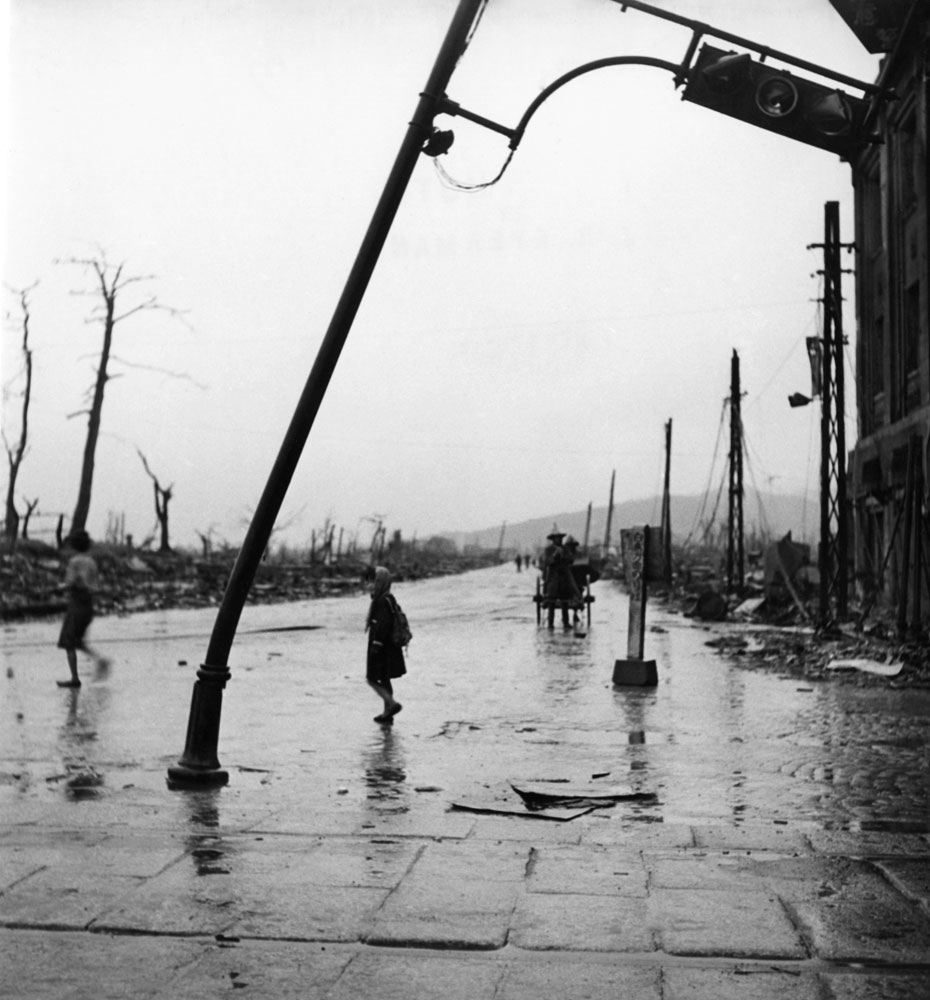
Yoshitaka Kawamoto was thirteen years old when the bomb exploded over Hiroshima, in a classroom less than a kilometer away from the hypocenter:
“One of my classmates, I think his name is Fujimoto, he muttered something and pointed outside the window, saying, “A B-29 is coming.” He pointed outside with his finger. So I began to get up from my chair and asked him, “Where is it?” Looking in the direction that he was pointing towards, I got up on my feet, but I was not yet in an upright position when it happened. All I can remember was a pale lightening flash for two or three seconds. Then, I collapsed. I don t know much time passed before I came to. It was awful, awful. The smoke was coming in from somewhere above the debris. Sandy dust was flying around. I was trapped under the debris and I was in terrible pain and that’s probably why I came to. I couldn’t move, not even an inch. Then, I heard about ten of my surviving classmates singing our school song. I remember that. I could hear sobs. Someone was calling his mother. But those who were still alive were singing the school song for as long as they could. I think I joined the chorus. We thought that someone would come and help us out. That’s why we were singing a school song so loud. But nobody came to help, and we stopped singing one by one. In the end, I was singing alone.”
A bit farther away at 3.7 kilometers, a chief weather man for the Hiroshima District Weather Bureau named Isao Kita describes his experience:
“Well, at that time, I happened to be receiving the transmission over the wireless. I was in the receiving room and I was facing northward. I noticed the flashing light. It was not really a big flash. But still it drew my attention. In a few seconds, the heat wave arrived. After I noticed the flash, white clouds spread over the blue sky. It was amazing. It was as if blue morning-glories had suddenly bloomed up in the sky. It was funny, I thought. Then came the heat wave. It was very very hot. Even though there was a window glass in front of me, I felt really hot. It was as if I was looking directly into a kitchen oven. I couldn’t bear the heat for a long time. Then I heard the cracking sound. I don’t know what made that sound, but probably it came from the air which suddenly expanded in the room. By that time, I realized that the bomb had been dropped. As I had been instructed, I pushed aside the chair and lay with my face on the floor. Also as I had been instructed during the frequent emergency exercises, I covered my eyes and ears with hands like this. And I started to count. You may feel that I was rather heartless just to start counting. But for us, who observed the weather, it is a duty to record the process of time, of various phenomena. So I started counting with the light flash. When I counted to 5 seconds, I heard the groaning sound. At the same time, the window glass was blown off and the building shook from the bomb blast. So the blast reached that place about 5 seconds after the explosion. We later measured the distance between the hypocenter and our place. And with these two figures, we calculated that the speed of the blast was about 700 meters per second. The speed of sound is about 330 meters per second, which means that the speed of the blast was about twice as fast as the speed of sound.”
The sky became reddish over Hiroshima, and saturated with smoke and dust. All who were alive and mobile quickly began to try to help the injured or flee the area, few realizing the magnitude of the destruction. The scent of char was on the air as fires began to break out around the city. Ninety percent of Hiroshima’s buildings has been pulverized or damaged by the pressure wave— which had swept virtually unhindered across the flat landscape of the area— and tens of thousands of people were dead or dying.
Of the survivors, Akiko Takakura was among the closest to ground zero at only three hundred meters. She was twenty years old at the time, and she had just started her morning routine at her job in the in the Bank of Hiroshima.
“Well, it was like a white magnesium flash. I lost consciousness right after or almost at the same time I saw the flash. When I regained consciousness, I found myself in the dark. I heard my friends, Ms. Asami, crying for her mother. Soon after, I found out that we actually had been attacked. Afraid of being caught by a fire, I told Ms. Asami to run out of the building. Ms. Asami, however, just told me to leave her and to try to escape by myself because she thought that she couldn’t make it anywhere. She said she couldn’t move. I said to her that I couldn’t leave her, but she said that she couldn’t even stand up. While we were talking, the sky started to grow lighter. Then, I heard water running in the lavatory. Apparently the water pipes had exploded. So I drew water with my helmet to pour over Ms. Asami’s head again and again. She finally regained consciousness fully and went out of the building with me. We first thought to escape to the parade grounds, but we couldn’t because there was a huge sheet of fire in front of us. So instead, we squatted down in the street next to a big water pool for fighting fires, which was about the size of this table. Since Hiroshima was completely enveloped in flames, we felt terribly hot and could not breathe well at all. After a while, a whirlpool of fire approached us from the south. It was like a big tornado of fire spreading over the full width of the street.”
29-year-old Tsutomu Yamaguchi was only in town because his employer Mitsubishi Heavy Industries had sent him there on a business trip. He was walking across a potato field on his way to work when he heard a plane flying high and saw two parachutes descending. His account at first seems ‘ordinary’ amid extraordinary horror:
“It was very clear, a really fine day, nothing unusual about it at all. I was in good spirits,” he said. “As I was walking along, I heard the sound of a plane, just one. I looked up into they sky and saw the B-29, and it dropped two parachutes. I was looking up into the sky at them, and suddenly…it was like a flash of magnesium, a great flash in the sky, and I was blown over.”
Half his face was badly burned, his hair gone, and his eardrums ruptured. Not knowing what else to do, he continued on to his employers’ offices—climbing over the bodies of the dead while weeping uncontrollably—and found only rubble awaiting him there.
Soon the control operator of the Japanese Broadcasting Corporation in Tokyo noticed that the Hiroshima station was off the air. Unaware of what had happened, he tried to re-establish his program by using another cable, but that attempt failed as well.

The Tokyo railroad telegraph center also discovered that the main telegraph line had stopped working just north of Hiroshima. From those stations which were within sight of Hiroshima and still in contact, confused telegraph reports of a terrible explosion began to arrive in Tokyo.
As the mushroom cloud towered over the city, the smoky sky churned with lightning and thunder. Within a few hours, a sticky black rain began to fall which blackened everything it touched. Makeshift hospitals treated overwhelming numbers of injured as thousands of wounded left the city and hundreds of people attempted to enter the affected area to find their loved ones.
Hiroshi Sawachika was an army doctor stationed at the army headquarters in the neighboring city of Ujina on that day:
“I was told to go to the headquarters where there were lots of injured persons waiting. I went there and I started to give treatment with the help of nurses and medical course men. We first treated the office personnel for their injuries. Most of them had broken glass and pieces of wood stuck into them. We treated them one after another. Afterwards, we heard the strange noise. It sounded as if a large flock of mosquitoes were coming from a distance. We looked out of the window to find out what was happening. We saw that citizens from the town were marching towards us. They looked unusual. We understood that the injured citizens were coming towards us for treatment. But while, we thought that there should be Red Cross Hospitals and another big hospitals in the center of the town. So why should they come here, I wondered, instead of going there. At that time, I did not know that the center of the town had been so heavily damaged. After a while, with the guide of the hospital personnel, the injured persons reached our headquarters. With lots of injured people arriving, we realized just how serious the matter was. We decided that we should treat them also. Soon afterwards, we learned that many of them had badly burned. As they came to us, they held their hands aloft. They looked like they were ghosts.”

Several hours later, word reached the Japanese government in Tokyo that some kind of catastrophic explosion had leveled the city. Sixteen hours after the event, Tokyo finally learned what had caused the disaster when the White House made a public announcement in Washington regarding the nuclear attack. Three days later, the city of Nagasaki was attacked by a second atomic bomb, and though the hilly terrain there protected much of the city, tens of thousands were injured and killed by the twenty-one kiloton Fat Man and the radiation it produced.
One man who happened to be in the city was 29-year-old Tsutomu Yamaguchi, the same survivor who had been in Hiroshima on business when the first bomb fell. He was standing in his employer’s office, wrapped in bandages, describing to his manager the recent events in Hiroshima. The manager had been expressing skepticism regarding Yamaguchi’s description of the magnitude of a single bomb. Just then a bomb of similar magnitude lit the sky outside, shattering the window and stripping Yamaguchi of his bandages. He fell to the floor, where a steel wall cast a shadow that shielded him from the worst.
Japan shortly surrendered, ending the Second World War.
Radiation sickness took many lives in the following days, and over two hundred thousand people were exposed to heavy non-fatal doses of radiation during the attacks and due to fallout in the intervening weeks. These men, women, and children who were exposed to the bomb are the hibakusha. This status entitles one to a monthly allowance from the government as compensation for injuries, since many of them have lingering health problems from which they will never recover. The radiation exposure has also left them much more susceptible to cancer.
Yamaguchi also survived his second brush with an atomic bomb, though he spent weeks in a shelter, near death. He awoke to find that his house had been torn to a ruin, but his wife and son had survived. He lived on until 04 January 2010, succumbing to stomach cancer at the age of 93. There were more than 100 others affected by both bombs to varying degrees, but Yamaguchi is the only person officially recognized by the Japanese government as a survivor of both bombs.

From the flattened ruins of Hiroshima and Nagasaki sprang new cities, each of which are vibrant and active places today. Most of the surviving hibakusha still live in Japan, which to date are numbered at 266,598. At last count in August 2005, the death toll from these atomic weapons stands at 379,776— some from the blast itself, and others from radiation and fallout exposure in the following months and years.
But health problems are not the only difficulties faced by the survivors of the nuclear attacks of 1945. A general lack of knowledge as to the effects of radiation has caused considerable discrimination against these individuals. It seems that a great number of Japanese citizens are under the impression that radiation sickness is contagious or hereditary, causing many communities to ostracize the hibakusha, and causing many employers to refuse to hire the hibakusha or their children even today.
The stories of the eyewitnesses to Hiroshima and Nagasaki are moving, though disturbing. May humankind never again use these instruments of colossal destruction against its own.
© 2006 All Rights Reserved. Do not distribute or repurpose this work without written permission from the copyright holder(s).
Printed from https://www.damninteresting.com/eyewitnesses-to-hiroshima-and-nagasaki/
Since you enjoyed our work enough to print it out, and read it clear to the end, would you consider donating a few dollars at https://www.damninteresting.com/donate ?
Amazing to think, a horrible thought if it had happened to the rest of the work (aka WWIII, Holocaust blah blah). The story of the weather man was very interesting.. Imagine that, seeing a blast in the sky a mile awayand having a heat wave rushing at you like the heat radiating out an oven.
One thing I’ve always wondered, especially after reading the stories of the outcast hibakusha, is a person who’s suffered a major dose of radiation somehow radioactive themselves. I mean, if you survive a dose of radiation with burns and product from a nuclear blast, is there enough collected on the skin to harm another person? Is there any truth to people being afraid of hibakusha?
Probably a stupid question.
“naaa, its just a few weather planes” they said,”those Americans and their weather”.
Boy, were they wrong.
Wow, I’m impressed that people survived 300 meters from the explosion. I bet they had some major radiation problems. Anyway, I wondeer why the city wasn’t evacuated prior to that day. I heard that the U.S. had warned them extensively in order to reduce civilian cassualties. (I’d like to think that we aren’t totaly evil) Plus, in using such weapons we saved alot of our own lives, which is much better then continuing the war and having more casualties on both sides. I definitely don’t think we should use them again but perhaps nuclear weapons we’re the best solution at the time. I feel bad for the hibakusha, they could definitely use some pie. Triple scoop the whip cream. Oh yeah, which government is giving them compensation?
kwiksand said: “
One thing I’ve always wondered, especially after reading the stories of the outcast hibakusha, is a person who’s suffered a major dose of radiation somehow radioactive themselves. I mean, if you survive a dose of radiation with burns and product from a nuclear blast, is there enough collected on the skin to harm another person? Is there any truth to people being afraid of hibakusha?
Probably a stupid question.”
I’ve heard that everyone is slightly radioactive, and almost everything is to a certain extent. However, I don’t think it’s nearly enough to hurt anything. Especially compared to sunlight. Anyway… you guys beat me! and by like a few minutes. oh well. I’ll go have some pie.
May humankind never again err so spectacularly as we did during that week in 1945.
I’m going to have to disagree on that one… It is unfortunate that the U.S. was forced into using nuclear weapons (which we didn’t fully understand at the time as far as the after effects go) but I don’t feel that we err’d. As Floj said, It ended the war much, much more quickly than any other means would have allowed which, despite the high death tolls in Hiroshima and Nagasaki, was beneficial to both the Japanese and the U.S.
US is evil. Japan is evil; serves those sukers right for screwing with provish chinese villages.
What a horrible thing humanity has unleashed upon itself. I’m in the Army, and my favorite military quote to this day is still “It is good war is so horrible, else we would come to like it too much.” – Robert E. Lee, after the battle of Fredericksburg (which he won).
As for “are people radioactive after a large dose”, I don’t think so, not in the way you’re thinking, kwiksand. I interpreted your question to mean “would someone who suffered such a large dose be pumping out the roentgens to others around them?”, and they don’t. Not if they survived, that is. You could pump enough radiation into ’em to kill them and turn their corpse into a radiation producing corpse, but no one still walking and talking would give off more radiation.
kwiksand said: “One thing I’ve always wondered, especially after reading the stories of the outcast hibakusha, is a person who’s suffered a major dose of radiation somehow radioactive themselves. I mean, if you survive a dose of radiation with burns and product from a nuclear blast, is there enough collected on the skin to harm another person? Is there any truth to people being afraid of hibakusha?
Probably a stupid question.”
It’s not a stupid question; there is good reason to be concerned about this. Here’s the straight dope:
There are two kinds of radiation that nuclear blasts emit, and they have very different effects. Unfortunately, since both are swept together with the lable “radiation”, people don’t understand the implications of the differing kinds of radiation.
The two broad categories of radiation are particle radiation, and electromagnetic radiation. Of the two kinds of radiation, only a subset of the forms of particle radiation can make something more radioactive. Electromagnetic radiation includes the flash of radiant heat (infra red), light, ultra-violet, and x-rays and gamma rays. UV rays, x-rays, and gamma radiation can all cause cancer, and when intense enough, all of them, even visible light and infra red will burn.
Of the particle radiation, the three dominant forms are alpha particles, beta particles, and neutrons. Beta particles are just electrons, and can be stopped with aluminum foil. Alpha particles are helium nuclei, and can damage DNA, but won’t make you radioactive; they can be stopped very effectively with lead shielding. Neutron radiation is the one to worry about if acquiring radioactivity is your concern; the balance of neutrons in an atom’s nucleus is the factor that determines radioactivity. Too many or too few neutrons will render an atom radioactive. For example, carbon is stable with 6 or 7 neutrons (a.k.a. carbon 12: 6 neutrons, 6 protons, and carbon 13: 7 neutrons, 6 protons.) However, carbon 14 has 8 neutrons, which is too many; carbon 14 is radioactive, and decays at a known rate, giving off radiation and particles until it changes into something else.
The folks merely exposed to the blast are not likely to be dangerously radioactive; the ones who were exposed to the fallout and the contaminated soil, water, and air might be. The radioactive ones are not radioactive because of particle radiation; that usually kills pretty quickly; their radioactivity usually comes from ingesting contaminated water or food which had bits of nuclear waste that rained down from above due to the nuclear blast.
Perhaps I should have added: the ones who died of particle radiation might not be walking around alive and radioactive, but their corpses would be pretty radioactive, if not dangerously so. Burrying them as-is would contaminate the soil, and cremating them would likely contaminate the air with the smoke of the cremation.
usagi_tetsu said: “As for “are people radioactive after a large dose”, I don’t think so, not in the way you’re thinking, kwiksand. I interpreted your question to mean “would someone who suffered such a large dose be pumping out the roentgens to others around them?”, and they don’t. Not if they survived, that is. You could pump enough radiation into ’em to kill them and turn their corpse into a radiation producing corpse, but no one still walking and talking would give off more radiation.”
It is possible to be walking around while dangerously radioactive. There is a small population of people who refused to leave the Chernobyl area after the reactor blew clean open. Somehow, their bodies adapted, and they are walking around alive, but dangerously radioactive. The Chernobyl area has become a default nature preserve; the place has been overtaken by wildlife, which has somehow thrived in the absence of humans, though all of it is quite radioactive.
I would not go as far as to say that humankind erred in using the atomic bomb; the error was warfare and aggression; the bomb was a necessary evil in response to a country that would not surrender and was willing to fight to the last man. The entire Japanese population was ready to die in defense of the homeland, and in preparing for the land invasion, fleets of suicide boats packed with explosives were prepared to meet our navy and our troops. They were willing to die to kill us, and we weren’t willing to die.
Nuclear weapons were a necesity for fighting a suicidal enemies bent on destroying us even if it costs them their own lives.
As sad as it is that we had to use the A-bomb, both Japan and Germany were working on weapons of mass destruction; imagine if a facist warlike country under the grip of a madman tyrand deluded by a twisted death-worshiping ideology got their hands on nuclear weapons. If they had gotten the weapon first, the world would be a much worse place today.
I also hate to bring this dire forecast, but I fear that we may once again face the threat of nuclear warfare: Iran’s madman president is hell-bent on producing nukes, even as he declares that they are for peaceful use. In all of the rest of his rhetoric, he says that Israel will soon be “wiped off the map”, and lo and behold: we have an enemy facist warlike country under the grip of a madman tyrand deluded by a twisted death-worshiping ideology whose Basiji militias are ready to die to the last man and woman to destroy us and Israel.
It looks like the next nuclear conflict will happen in the middle east. I kid you not.
this is the weatherman, today will be slightly cloudy with a 100% chance of death.
Dr. Sasaki was a doctor at the red cross hospital in Hiroshima and a survivor. Some time after the bomb he stated “I see that they are holding a trial for war criminals in Tokyo just now. I think they ought to try the men who decided to use the bomb and they should hang them all.”
That being said, I think the Iranian president is full bore loony but I don’t think George Bush is any less so. Dangerous times.
Berkana said:
I also hate to bring this dire forecast, but I fear that we may once again face the threat of nuclear warfare: Iran’s madman president is hell-bent on producing nukes, even as he declares that they are for peaceful use. In all of the rest of his rhetoric, he says that Israel will soon be “wiped off the map”, and lo and behold: we have an enemy facist warlike country under the grip of a madman tyrand deluded by a twisted death-worshiping ideology whose Basiji militias are ready to die to the last man and woman to destroy us and Israel.
It looks like the next nuclear conflict will happen in the middle east. I kid you not.”
Are you as sure about that as Bush was that Iraq was producing/buying nukes ? Sure, I agree that Iran’s president is a nutcase, but so was Saddam, wasn’t he. And yet most of what he boasted never actually existed. If the US and Israel are going to use preemptive nuclear strikes against Iran, this indeed would be, in my view a great err. Once you create a precedent for pre-emptive nuclear strikes, there’s nothing stopping you from going after anyone else you don’t like and can label as a “threat”. Not to mention this would make Russia not-happy as well. While I am aware that we are talking about bunker-buster missles here and surgical strikes and all that, not direct hits against cities and civilians, we all know just how surgical surgical strikes can be. The US and Israel might be opening up a whole new can of whoopass that neither of them can handle.
although I agree that Iran’s President Mahmoud Ahmadinejad is not a very nice man, he did not say that Israel should be wiped off the map. Neither did he deny the holocaust.
Some American translaters,problably employed by Bush, purposely translated him wrongly.
*It looks like the next nuclear conflict will happen in the middle east. I kid you not.*
I completely agree. People who believe in a the fairytale of a next life don’t care very much about this one.
“I completely agree. People who believe in a the fairytale of a next life don’t care very much about this one.”
Especially people who look forward to Armageddon.
Albert Einstein once said “World War 4 will be fought with ROCKS” so much truth is in that
The actual winners of battles (the men who fought them, not the people who sit at desks hundreds or thousands of miles away) almost never like war. Eisenhower HATED war.
And religious people who expect an end of the world give me the heebie jeebies…
Floj said: “… I wondeer why the city wasn’t evacuated prior to that day. I heard that the U.S. had warned them extensively in order to reduce civilian cassualties. “
You mean like this?
this is the weatherman, today will be slightly cloudy with a 100% chance of death.
Funny thing about living … no one gets out alive.
Armani said: “US is evil. Japan is evil; serves those sukers right for screwing with provish chinese villages.”
Even though I’m usually against being that blunt I have to agree what Japan did was preety bad. They did an special on it what all happened that caused the Hiroshima and Nagaski to happen (quick bit of tid bit the locations weren’t choosen until the men were about to go bomb). Japan during that time did some preety crazy stuff towards the Chinese such as beat villages to death with stones, sticks, anything they could find since they’re leaders said the Chinese weren’t worth feeling their swords and guns. Amercia has always done convert or suspecious behavior (such as that in the Cold-War and giving terrorist groups in Iraq money to fund they’re wars to kill of the Russians any means nessecary).
Enough about talking about the evils of both countries I have one question I thought they knew it was an actual plane not a weather plane? Just because Americans had flown the planes overhead so much they thought nothing of it anymore is what I heard. Also said that the Japanese warned their people with an alert system but yet again since the planes were flown overhead so much they thought nothing of it?
student said: “”I completely agree. People who believe in a the fairytale of a next life don’t care very much about this one.”
Especially people who look forward to Armageddon.”
I’m looking forward to the beer volcano myself.
Too all you sick Americans who think that this bomb was a fun idea, remember it couldn’t have been put into play without us Canadians. You guys bought our uranium and other radioactive metals for Hiroshima.
…Although I was not even near close alive, and niether was my dad, I feel slightly to blame.
oh, and…
“Once you create a precedent for pre-emptive nuclear strikes, there’s nothing stopping you from going after anyone else you don’t like and can label as a “threat”. Not to mention this would make Russia not-happy as well.”
True that. The United States are idiots (no offence to the people on this board). I say that because look what’s happening. Instead of pulling their troops out and ending this damn war, they stay it, and then theres rumors that another countrry may get in the fight. Next thiung you know, Russia’s backing up Iran and Iraq, and sooner or later we’ll get WW3. Seriously; Bush wanted oil. Bush faked 9/11. Bush attacks the president of Iraq and others, and wins. Bush destroys lots of nuclear weapons. He now has NO FREAKING REASON to continue fighting. If he wasn’t so STUPID, we’d all be back in peace time, taxes would be a little lower, and oil prices will drop substancially.
Catkilller7 said: “Too all you sick Americans…Bush faked 9/11. “
Go post somewhere else troll.
Bush didn’t fake 9/11. He just decided to blame Saddam for it, even though Saddam has nothing to do with Al Qaida, because he wanted a war with Iraq.
…yeah right…nobody likes the United States…but most other countries in the world like US financial assistance, US foods and grains, US protection and host of other US services that are basically paid for out of my pocket. The US may not have all the answers, heck, it may not even have the right answers, but at least the US is trying and THAT is more than the rest of the world can say. If they don’t like our politics, ideology, freedom of speech, democratic ways…they are welcome to fend for themselves. As some contributors have pointed out before, we have enough problems of our own to solve in this country without trying to solve everyone elses. Don’t you just luv April 15th?
Me thinks..sadam gave all the weapons of mass destruction/technology to iran… He did it once with his military jets during desert storm. whos to say he didnt do it with the chemical weapons (which history has documented that he used on villagers)
im saying iran nuke program got accelerated due to sadam feeding them technology and whatever they had. Far fetched? no as far as saying 9/11 was a fake.
As soon as the mainstream media reported that “evil” Bush was contemplating nuclear (that’s noo-kyew-lar folks and if Jack Bauer says it that way, its gotta be right!) strikes against Iran, articles like this were inevitable. Look for scads of horror stories and films about how terrible nuclear war is to pop up on TV and in the movies. I for one hope we don’t carry Israel’s water again by attacking Iran (lots of Holocaust movies are also about to hit the boob tube to get us primed for that), but with nut cases like Iran’s prez, what’s a body to do? All of the actors in this drama seem to be intent on going all the way on this one. I hope Dubya can find a non-lethal way out of it though. Oh, almost forgot: Catkiller you really need some serious therapy. Too much Starbucks and weed in your diet.
Wove,
Twisty
Hiroshima and Nagasaki are a direct result of Perl Harbor. We did not want war.
Hmmm…Israel doesn’t need US help, and they shouldn’t be taunted…they can probably whip any/all of their neighbors with even one hand tied behind their back. Reason…think about this…if Israel loses even one fight, they have nothing left. As such, they WILL win to hold on to the little bit of land they have by the sea. They need to ensure they have a place to land their air force when the fighting is done.
It is a shame that those that want to embrace peace must use so much force to uphold it!
The bombing of Hiroshima will be debated as a right or wrong thing to do for ages to come. I wish I had a fully formed opinion about that one.
The bombing of Nagasaki, however, was undeniably stupid, stubborn, evil, redundant, and sadistic.
WOW, ” hibakusha. This status entitles one to a monthly allowance from the government (Japan) as compensation for injuries, since many of them have lingering health problems from which they will never recover. ” Why doesn’t the US government do anything bout all that, seems kinda fuked up, killing all those innocents.
All I know is that these two bombs saved my grandfathers life. I could care less how many jap lives were lost as long as he survived. He didn’t talk about WW2 much but he did tell me about a suicide mission he was to be involved in. He said the mission was to go thru the streets of Tokyo shooting everyone who wasn’t American until they ran out of bullets or died. He knew he wouldn’t survive the mission and just days before the mission the bomb was droped. The mission was put on hold hoping the japs would surrender and they finally did.
I have a Jap rifle in my safe right now that he brought home from Japan. It is a reminder to me what he went through 61 years ago. He never forgot who the enemy was back then and what they wanted to do to Americans and he was very happy with me when I drove a Honda to his house either.
The one thing I am sure of is these two bombs saved the life of the finest man I have a ever known and ever jap life lost on those two days were worth less than his.
That incident, to date, has been the only instance of an atomic bomb being used in an attack. Hopefully we don’t have to see that happen again. The quotes by those people were cool… especially the schoolboy quote.
shrike said: “Dr. Sasaki was a doctor at the red cross hospital in Hiroshima and a survivor. Some time after the bomb he stated “I see that they are holding a trial for war criminals in Tokyo just now. I think they ought to try the men who decided to use the bomb and they should hang them all.”
Yet the Japanese war criminals who carried out atrocious crimes against civilians in China are enshrined as war deities at the Yasukuni shrine. . .
Sasaki only saw what Japan had coming. If he knew even a fraction of the horror Japan unleashed upon the Phillipines and China and everywhere else their army overran, he might understand the horror we were facing and why we chose to use the bomb. Then again, he might never understand; to some ultrapatriots, their country could never be wrong.
Japan tried to unleash the boubonic plague on our civilian population by floating ceramic vessels filled with infected fleas over the jetstream by balloon. The attempt failed, though at least one of their plague-bombs landed in the US. I’m just glad the bomb ended the war swiftly; Japan would not have hesitated to use the bomb as many times as they wanted in ther lust for conquest. We just wanted to end the war and spare our troops from the hell Japan had prepared for us if we were to have had a land invasion. And their population was ready to commit mass suicide if it a land invasion were to have succeeded; hundreds of civilians on Okinawa jumped to their deaths and committed suicide when we succeeded in taking the island. I can’t imagine what would have happened if we had invaded the main islands.
pwu said: “im saying iran nuke program got accelerated due to sadam feeding them technology and whatever they had. Far fetched? no as far as saying 9/11 was a fake.”
Sir, you forget that Sadam invaded Iran and that the Iranians hated his guts. The Iran Iraq war caused several hundred thousand Iranian lives. Or do you just lump them all together as Muslims? They aren’t even the same ethnicity, nor the same faction of Islam. Iraq is Arab, Iran is Persian. They don’t even speak the same language. (Their languages are both written using the Arabic alphabet, but that’s akin to German and English both using the Roman alphabet.)
klone said: “WOW, Why doesn’t the US government do anything bout all that, seems kinda fuked up, killing all those innocents.”
It’s not our fault that the japs decided to attack pearl harbor. It was the Jap government that decided to attack our innocents, we mearly returned the favor. We don’t ask them to pay a monthly sum to people or people’s families that survivded pearl harbor. Their attack was way too premeditated for us to have that much sympathy for their country.
karphi said: “The bombing of Hiroshima will be debated as a right or wrong thing to do for ages to come. I wish I had a fully formed opinion about that one.
The bombing of Nagasaki, however, was undeniably stupid, stubborn, evil, redundant, and sadistic.”
Bombing Nagasaki only happened because we didn’t understand the Japanese, and the Japanese didn’t understand that we didn’t understand them. After Hiroshima, Japan was so shocked that it was ready to surrender, but their military literally didn’t have the protocols nor the vocabulary for surrender, and they hesitated. In light of what we had seen Japan do in prior encounters, our military thought “Holy crap. They won’t surrender! Hit them again!” and we lobbed another bomb, in spite of the fact that all Japan needed was a good deal of time.
As the emperor of Japan had prepared a surrender record for broadcast, a faction of ultra-patriots actually took over the emperor’s palace and tried to prevent the broadcast. If they had succeeded, we might have ended up nuking Japan over and over until they were all dead. Upon broadcasting the message of surrender (actually, the message was more subtle: the emperor simply stated that they had decided to stop fighting) many Japanese killed themselves.
Berkana said: “Sir, you forget that Sadam invaded Iran and that the Iranians hated his guts. The Iran Iraq war caused several hundred thousand Iranian lives. Or do you just lump them all together as Muslims? They aren’t even the same ethnicity, nor the same faction of Islam. Iraq is Arab, Iran is Persian. They don’t even speak the same language. (Their languages are both written using the Arabic alphabet, but that’s akin to German and English both using the Roman alphabet.)”
And Did you not read my previous post where i pointed out the desertstorm incident where iraq sent its fighters to iran to escape us bombings? Im just saying its not that far a leap from planes to nukes.
i suppose anyone who wasn’t american meant white anglo-saxon male huh? a bit racist if you ask me.
war is an awful thing.
Berkana said: “Bombing Nagasaki only happened because we didn’t understand the Japanese, and the Japanese didn’t understand that we didn’t understand them. After Hiroshima, Japan was so shocked that it was ready to surrender, but their military literally didn’t have the protocols nor the vocabulary for surrender, and they hesitated. In light of what we had seen Japan do in prior encounters, our military thought “Holy crap. They won’t surrender! Hit them again!” and we lobbed another bomb, in spite of the fact that all Japan needed was a good deal of time.
As the emperor of Japan had prepared a surrender record for broadcast, a faction of ultra-patriots actually took over the emperor’s palace and tried to prevent the broadcast. If they had succeeded, we might have ended up nuking Japan over and over until they were all dead. Upon broadcasting the message of surrender (actually, the message was more subtle: the emperor simply stated that they had decided to stop fighting) many Japanese killed themselves.”
From what I understand, the Japanese leadership was in a deadlock on surrender or keep fighting. The emperor at the time had to break the deadlock. Japan had an understanding that making a nuke was a very difficult task and actually questioned if the US had anymore bombs. Once the second bomb dropped. the emperor had more conviction to break the deadlock for surrender.
Very good article well worth reading, I’ve always had a rather macabre interest in what was seen and felt that day, and thanks to this i have some useful insight
Something that is forgotten in the wake of the A-Bombing is the hundreds of thousands that were burned to death
in the fire bombing of other MAJOR cities (Tokyo was the first). The bombings of civilians is considered a war crime by some including
Robert mcnamara himself who performed the statistical analysis that demonstrated the effectiveness of such bombing that lead to the policy change to “firebombs” (he later became United States Secretary of Defense under John F. Kennedy). In short although the Atomic Bomb is significant, more were already being burned alive in the nighttime raids.
http://www.commondreams.org/headlines05/0310-08.htm
http://en.wikipedia.org/wiki/Bombing_of_Tokyo_in_World_War_II
http://en.wikipedia.org/wiki/Robert_McNamara
student said: “”I completely agree. People who believe in a the fairytale of a next life don’t care very much about this one.”
Especially people who look forward to Armageddon.”
Hi, I’m one of the nutjobs that totally expects an afterlife, and an Armageddon type event, but I’m certainly not “looking forward” to that Armageddon. Human life is precious, but this world is a crazy place to live in, and men will be bent on killing and conquest right up until a day of reckoning. We’ll bring ourselves to that point – sure, history teaches great lessons, but I don’t think we’ll ever learn them. War is often just self-defense on a grand scale, and Hiroshima and Nagasaki were the final blow justly dealt by a nation trying to protect the planet from (what was then) a nation led by murderous fanatics.
I think this debate is definately taking successive wrong turns. The use of nuclear weapons in a war was not wrong. This is not a matter of who did more wrong to who. This is a matter of war. The means in which nuclear weapons were used however, eg: targetting civilians and civilian installations, that was wrong.
And no, it canno be considered a ‘response’ to Pearl Harbour either, because Pearl Harbour was a military attack on military forces, with 2400 casualties and only 68 casualties on the civilian side. The Hiroshima bombing left 80000 dead and the Nagasaki bombing left 39000 dead, out of which the majority had been civilians living in the city. You need to be blind not to see the difference in proportion and morality.
It is also true however that, in those days, war was a lot different, and human life during war had a much lesser importance apparently, than the actual goal of prevailing over the enemy. The perception on war was different and thus the implied morality of certain actions were different as well.
Berkana said:
We just wanted to end the war and spare our troops from the hell Japan had prepared for us if we were to have had a land invasion.
Would you aprove of the same tactics today? Why waste any soldiers at war? Just nuke their cities until they surender? You think that might be a plausible scenario?
Also, the problem of nuclear action and more importantly PRE-EMPTIVE nuclear action today is a lot more complicated with all the media manipulation, distrust and misinformation going on. Who do you trust? Who do you know is telling the truth? And how far does it go?
My thoughts to the rationalie of droping the bomb is in line with..We are doing it to save lives. Would I support it today with our military and our capabilities? probably not. However, at the time, to end the war, invasion of Japan was inevitable. With the mentality of the japanese military and citizens, they would have defended the country till the end. Men, woman and children. What would the death toll be then? How many military deaths? how many civilians?
Anonymous User said: “The one thing I am sure of is these two bombs saved the life of the finest man I have a ever known and ever jap life lost on those two days were worth less than his.”
Wow, that’s selfishly pathetic. Your comments are void, you racist.
I went to Hiroshima this past summer while in Japan and it was a unique experience. In the second picture of the article, the building with the dome (now called the A-bomb Dome) is still standing as it did after the blast. At the hypocenter they have a whole archive of testimonies from people who were there similar to those in the article. After visiting, I do not think the use of atom bomb can ever be justified.
The U.S. is in Iraq due to “Peak Oil”. Google it. We know we needed to get our military asses over there and 9/11 was the perfect (well not perfect) excuse to go. We aren’t leaving, that’s why there’s no withdrawal plan. The country that controls the last amounts of oil controls the world.
What I have never understood is why we dropped the 2nd bomb. We should have given them more time to understand what had happened. I also don’t understand why we did not drop on a military base. It hurts me to read this. I hate that our country did this to a city. I also hate that we get on to countries for doing the same thing we did to become a country. Our founding fathers were criminals and terrorists. I promise that is what somebody would be branded today for doing the exact same thing. We pay more taxes now than our founding fathers fought against.
I believe there were several reasons for our bombing Japan.
1.) Revenge for Pearl Harbor. We were humiliated in front of the entire world, we lost a lot of lives, and we decided to get revenge tenfold.
2.) We invested a shitload of money into developing the bomb. I believe the budget towards its production was something like $2 billion (which isn’t THAT much today, but back then it was probably a substantial chunk). Now, why let an investment that big go to waste?
3.) We wanted to test out our cool new technology. Hiroshima and Nakasaki were sort of like testing grounds for an experiment.
4.) We wanted to show off our superiority to the Soviet Union and intimidate them.
After reading into this, I’m not convinced that the bomb was completely necessary. There’s a lot of evidence saying that Japan planned on surrendering anyway, before we dropped the bomb, and that the government knew this and chose to ignore it.
In any case, as an American I feel guilty and partially responsible for this even though I wasn’t alive (and all of my grandparents and great-grandparents were in Ireland). I do get sad every time I watch a documentary or see pictures of the victims.
We certainly made a point though.
By the way, the entire Albert Einstein quote is “I don’t know what weapons we’ll use for WW3, but for WW4 we’ll be using sticks and stones.”
Brilliant.
I’ve been to Hiroshima and met a survivor. The experience made my skin crawl. Dropping that bomb was an awful thing to do. If I’d been Truman, I’d have done exactly the same thing.
What else was he to do? Anybody who thinks we should have held back should read up on the battle of Okinawa, fought in the spring of 1945. To hold that island, the Japanese sacrificed 100,000 dead. And that just counts the troops. About 150,000 civilians lived on the island; 50,000 of them died, many through suicide. American soldiers watched in disbelieving horror as mothers threw their babies off cliffs, then jumped after them. As for our guys, they suffered over 72,000 casualties, including 18,000 dead–over four times the number of Americans killed in the Battle of the Bulge. All for one lousy island.
Americans were horrified, and with good reason. If the enemy would fight so fanatically for Okinawa, what would they do when the US Pacific Fleet tried to roll into Tokyo Bay?
It’s easy to sit in a comfy chair and criticize the atrocious bombing of Hiroshima and Nagasaki. But imagine you’re Harry Truman, the guy who’s got to send thousands of Americans to their deaths. Your scientific advisor comes to you and says, “Mr. President, we’ve just invented a bomb so powerful, one of them can wipe out a whole city. It could end the war almost overnight. It’ll kill huge numbers of Japanese, but our boys will live.”
What would you have said in reply? Horrible as it is, I know what I would have said: “Bombs away.”
lolololol canada!!! lololololol
@ Floj.
That ridiculous pie reference was eye-rollingly unfunny many posts ago. Let’s give it up, m’kay?
stacksmasher said: “Hiroshima and Nagasaki are a direct result of Perl Harbor. We did not want war.”
Possibly – but our oil embargo of Japan may have made them slightly mad at us… see they had this oil crisis too… just think what a Liter of gas would have cost them then… maybe only if they had more efficient cars…
From wikipedia – http://en.wikipedia.org/wiki/Attack_on_Pearl_Harbor
and I post this because as Americans we should be AWARE of this.. but most people just dont know the history of WWII in the pacific pre Pearl Harbor…
The U.S. and UK disapproved of Japan’s actions, and responded with diplomatic pressure, condemning Japan’s aggression in China. Japan didn’t back down, but instead continued its military campaign in China and formally aligned itself with the Axis Powers in 1940.
The U.S. responded with economic sanctions
, including partial or full embargoes of scrap metal and gasoline, renouncing previously signed trade agreements between the two countries, and closing the Panama Canal to Japanese shipping. Again, the Japanese didn’t back down and, in 1941, invaded northern Indochina.
The U.S. response was to freeze Japanese assets and initiated a complete oil embargo.
Oil was the most valuable and crucial resource that Japan required. In addition to fueling Japanese military operations, oil was vital for core economic activities. 80% of Japan’s oil imports came from the U.S.[2] Diplomatic negotiations climaxed with the Hull note of November 26, 1941, which Prime Minister Hideki Tojo described to his cabinet as an ultimatum.
Therefore, Japan felt pressured to make a decision — either comply with the U.S. and UK demands backing down from its aggression in China and the surrounding areas, or go to war with the U.S. and its allies.
Concerned over losing their hard-earned status and prestige in the international community if they backed down (“loss of face”) and the perceived threat to their national security posed by the western powers who controlled territory in the Pacific and/or east Asia, Japan decided to pursue the latter option.[3]
Damned if it seems like history is repeating itself…
I have been to Hiroshima twice. Standing by the Genbaku Dome (the only original structure within the total destruction radius left standing as a memorial) and realizing the horror that was inflicted upon that city would make anyone with an ounce of sympathy feel terrible. The people of Hiroshima had no more say in whether or not to bomb Pearl Harbor than I did in deciding whether we should invade Iraq, but yet many of them (a lot of them children) were burned black and irradiated and killed in one of the most horrible manners possible. This is the true horror of war.
I don’t think many people will disagree that Japan as a country deserved what happened to it. Pearl Harbor, the Rape of Nanking, the POW camps that were almost extermination camps (almost 40% of US military personnel in Japanese POW camps died vs. ~1% in German POW camps), the treatment of B-29 pilots who bailed out over Japan (only 4% survived Japanese captivity) – all these things are the signs of a pretty evil government that the Earth is better off without. However, the average Japanese citizen of the cities the US destroyed with both the atomic bombings and the firebombings had no say in these activities. Yet they were the ones who paid with horrific deaths. All wars kill people who are just innocent bystanders and this is the truly evil and immoral horror of war. One that is too easy for the politicians to forget, because they never or rarely pay this price themselves. FDR decided that what was done to Hiroshima was worth it to rid the world of Imperial Japan that had attacked his country in a surprise attack, and maybe he was right. George Bush decided that he should start a war with Iraq to guarantee his Neo-Con vision of a “New American Century”. I sincerely doubt he was right about this.
62 million people died in WWII. 37 million of those were civilians. 25 million of them soldiers. 1.7 to 2 million people died in the 6 month or so Battle for Stalingrad alone. 300,000 people died from starvation in Stalingrad.
War is very difficult but the use of Nuclear weapons at the end of WWII was not the pentultimate devestation that people seem to think it was. Alot more people died far more horrible deaths in other places in that war, it just took weeks instead of moments. The bombing of Japan has importance for what it meant for future war and weaponry, but in the context of this war it is easy if not trivial to argue that it saved lives on both sides. Total killed in the bombings: around 300,ooo if you include some of the statistics of later related deaths. Which amounts to .04% of the casualties in WWII.
ogletree said: “What I have never understood is why we dropped the 2nd bomb. We should have given them more time to understand what had happened.
You’ve got to remember that back then, nobody had ever built an atomic bomb before. Many people thought that producing just one was impossible, let alone multiple bombs. By dropping two, we showed Japan that we in fact were capable of producing multiple atomic bombs and our threats were serious. The second bomb gave them no choice but surrender.
Berkana said: “…imagine if a facist warlike country under the grip of a madman tyrand deluded by a twisted death-worshiping ideology got their hands on nuclear weapons.”
Althought the above quote was in reference to Germany and Japan, it’s interesting how aptly it can be applied towards either the US or Iran, depending on one’s world view, of course.
The more things change, the more they stay the same.
Zach said: “I went to Hiroshima this past summer while in Japan and it was a unique experience. In the second picture of the article, the building with the dome (now called the A-bomb Dome) is still standing as it did after the blast. At the hypocenter they have a whole archive of testimonies from people who were there similar to those in the article. After visiting, I do not think the use of atom bomb can ever be justified.”
I was there several years ago and had the same experience. I’m not a very emotional person and went into the museum without any bias one way or the other, but after touring it I sat down on a bench in the park and completely broke down in tears over man’s inhumanity to man. It has nothing to do with what nation or culture you’re from – something of that magnitude breaks down all barriers.
Armani said: “US is evil. Japan is evil; serves those sukers right for screwing with provish chinese villages.”
right on – i was born in Harbin, China and i went to visit Japan’s unit 731 Germ factory(google it) horibble, horiblle. If you were there you say that the Jews and the gas chambers and ovens had it easy.
The bomb was right, they would of never gave up, even though both their land and sea war was failing, they would of fought for a long time.
Oh and somebody saying something about that the US warned them days in advance, come on thik about it,
US: hi, Japan? yeah we got this big bomb that were gonna drop on ya in Hiro and Nagi, with this slow ass plane that was hella vulnerable, so were telling you this so you can get all the people out of there.
Japan: Oh, thanks US we’ll evacuate, and since you told us, we’ll let you slip in and we won’t put up a defense.
come on, no one warns anyone back then, its not like Irag II, where we had a scheduled listing (practically) for the time that the Shock and Awe was going to start.
This debate will know no end, the same as other such debates have not.
Many have quoted Einstein, I’ve chosen to quote Kubrick, whose words impressed in a more global sense.
I feel that much of the nuclear threat is exagerrated, and I also fear that it won’t be nuclear weapons we will fear _when_ WWIII happens, because I in all conviction trust that sooner or later, it will. But regardless of the weapons used, this quote remains standing.
“The destruction of this planet would have no significance on a cosmic scale: to an observer in the Andromeda nebula, the sign of our extinction would be no more than a match flaring for a second in the heavens: and if that match does blaze in the darkness there will be none to mourn a race that used a power that could have lit a beacon in the stars to light its funeral pyre. The choice is ours.”
— Stanley Kubrick
“May humankind never again err so spectacularly as we did during that week in 1945.”
Nor as we did on Dec 7th, 1941.
Personally I think the US was justified in ending as quickly as possible a war we didn’t start, without any further loss of US servicemen and women’s lives. However, I question the decision to nuke civillian cities instead of relatively secluded military bases. The latter would have been an equally effective demonstration of the new atomic bomb, and would have just as well forced the Japanese govt into an immediate unconditional surrender.
Alan Bellows, great article. During war everyone gets wrapped up in rhetoric and it’s easy to hate a whole race but let’s remember, that we are all human beings. There were parents that got up that morning, hug their children and sent them off to school before going to work themselves not realizing they would never see each other again. There were people with hopes and dreams not much different than in the USA. I only hope there are those in Japan that feel the way I do about Hiroshima when they read about Pearl Harbor today. In war, we all lose something; our humanity.
Anonymous User said: “The one thing I am sure of is these two bombs saved the life of the finest man I have a ever known and ever jap life lost on those two days were worth less than his.”
Doesn’t everyone think their grandfather is the greatest ever?
To those who believe the second bomb was needed to give the illusion that we had more (which we didn’t, if I’m not mistaken, after the 2nd), one must take into account the target. It could have been dropped, oh, say, a few dozen miles out to see to prove that very point. It was vengeance, just like the bombing of Dresen and other places.
apology said: “”The destruction of this planet would have no significance on a cosmic scale: to an observer in the Andromeda nebula, the sign of our extinction would be no more than a match flaring for a second in the heavens: and if that match does blaze in the darkness there will be none to mourn a race that used a power that could have lit a beacon in the stars to light its funeral pyre. The choice is ours.”
– Stanley Kubrick”
The entire human race is visible from what? Ten thousand stars? Twenty thousand? There are several hundred billion stars in our galaxy, all of them much closer than Andomeda.
Space is big, really big.
bryon said: “@ Floj.
That ridiculous pie reference was eye-rollingly unfunny many posts ago. Let’s give it up, m’kay?”
A great article and lot’s of thought provoking comments and that’s all you picked up on? Let’s all play nice and let Floj have his pie.
As the emperor of Japan had prepared a surrender record for broadcast, a faction of ultra-patriots actually took over the emperor’s palace and tried to prevent the broadcast. If they had succeeded, we might have ended up nuking Japan over and over until they were all dead.
I can’t give a source for this, but I remember reading that those two bombs were in fact all we had. So if Japan hadn’t surrendered after Nagasaki we would still have had to invade.
apology said: “Are you as sure about that as Bush was that Iraq was producing/buying nukes ? Sure, I agree that Iran’s president is a nutcase, but so was Saddam, wasn’t he. And yet most of what he boasted never actually existed. If the US and Israel are going to use preemptive nuclear strikes against Iran, this indeed would be, in my view a great err. Once you create a precedent for pre-emptive nuclear strikes, there’s nothing stopping you from going after anyone else you don’t like and can label as a “threat”. Not to mention this would make Russia not-happy as well. While I am aware that we are talking about bunker-buster missles here and surgical strikes and all that, not direct hits against cities and civilians, we all know just how surgical surgical strikes can be. The US and Israel might be opening up a whole new can of whoopass that neither of them can handle.”
Its a mistake to confuse Iraq with Iran. Thats a war the U.S. doesnt want to fight, it wont go nearly as smoothly as Iraq and Bush knows it…..well his advisors do.
Mind you the U.S would win, but it would take alot of bodies and alot of money. Not to mention more public opinion than Bush can currently muster.
myname said:
Mind you the U.S would win, but it would take alot of bodies and alot of money. Not to mention more public opinion than Bush can currently muster.”
Cool! It’d be “Mission Accomplished” and “Bring it on” all over again! Let’s do it! Smooth and successful, baby!
(Sorry, drinking and posting. That should sound sarcastic.)
Japan had those bombs coming in a BIG way. The Japanese Empire was characterised by tyrany and oppressive rule of their annexed teritories. The things that the Japs did to those they conqured was horrible and what they did to POWs was even worse. I can’t give extensive examples but do a Wikipedia search for the Batan Death March to see how they treated POWs. If you want to see how well they treated Korean women do a search for Comfort Women.
Besides how do you defeat an enemy who routinely martyers themselves without killing off evey last one of them? You drop a couple of big ass bombs on ’em, that’s how.
Fun fact: one of the main causes for Pearl Harbor was that the US stopped supplying the Japanese with oil after invading French Indo-China (modern day Veitnam)
Funny how our modivations for war don’t really change that much over time.
For me the question is wether or not you can moraly justify the bombing of blatantly civilian targets.
Say what you want about Pearl Harbor, I being an American feel as strongly about it as most, but I recognize that it was an military target through and through. In fact I’d go so far as to call it a staple of “surgical” strikes. Say what you want about the preemptiveness of the attack, the bombing was executed as well as can be hoped.
What WE did was drop two amazingly high yeild bombs into the hearts of two major cities, inflicting a civilian death-toll that was absolutely unacceptable, when bombing military targets or around populated areas would have been nearly, if not as effective. If not in the case of the first bomb the surely the second.
If you want to argue the issue of reciprocity, in other words that the bombing was ok becuase of what was done at Pearl harbor, then you get into this isssue: Is an immoral act made moral simply because it was done to you? Or is immorality constant, uneffected by circumstance? If a man brutaly assaults your daughter is it ok to assult his? Or is each instance equally destestable? I suppose it comes down to standards.
Spike said: “A great article and lot’s of thought provoking comments and that’s all you picked up on? Let’s all play nice and let Floj have his pie.”
..right. You find the silly pie references “thought provoking”?
Sorry to repeat what you posted earlier, Ironclaw. Guess I should read all the posts before posting my own…
kood said: “Wow, that’s selfishly pathetic. Your comments are void, you racist.”
Interesting. So how many strangers lives would you trade for one of your loved ones? Me personally, entire nations could kick the bucket to keep my family alive. I guess some folks care more about strangers than their own blood.
To comment on Iraq:
If Bush did nothing else when he started a war there, he brought the war to the doorstep of the terrorists. I’d much rather fight a war thousands of miles away from my home than in my own backyard. Where terrorists would normally be planning the next 9/11, they are now making IED’s and firing RPG’s at passing convoys in his own backyard. That doesn’t entirely justify it but I think that it’s a definate plus.
aliceglass said: “Doesn’t everyone think their grandfather is the greatest ever?”
Screw that.. My Grandad fought in WWII As well for the Australian Army, and served time in a POW camp somewhere along the Thai Burma railway. The guy’s a prick. I do think he’s a hero for having survived it though, I imagine that was a horrifying experience.
Spike said: “Alan Bellows, great article. During war everyone gets wrapped up in rhetoric and it’s easy to hate a whole race but let’s remember, that we are all human beings. There were parents that got up that morning, hug their children and sent them off to school before going to work themselves not realizing they would never see each other again. There were people with hopes and dreams not much different than in the USA. I only hope there are those in Japan that feel the way I do about Hiroshima when they read about Pearl Harbor today. In war, we all lose something; our humanity.”
I’m not usually a terribly emotional person, but that bought a tear or two to my eye. I hope (with some small glimmer of hope, that is), that I can go through my life, and when I have kids they can go through theirs, without something of this magnitude happening again. That goes for anywhere in the world.
white_matter said:
Me personally, entire nations could kick the bucket to keep my family alive.
Goes to show how alike rednecks and terrorists really are.
Regarding Mart – “although I agree that Iran’s President Mahmoud Ahmadinejad is not a very nice man, he did not say that Israel should be wiped off the map. Neither did he deny the holocaust.” “Some American translators, probably (I am correcting your fifth grade level spelling) employed by Bush, purposely translated him wrongly.” This is your opinion, no one else’s. Get a life, what fairytale land do you reside in?
The actual warning to the government of Japan (emperor) had been issued days ahead of the attacks and reissued after the first bomb. The Japanese were warned after bomb one and failed to respond. Remember, we are talking about a nation who first came up with the ideal of Kamikaze; which, by the way, is very similar to the modern Jihads.
Catkiller7, man, what sort of crack are you on?!?!?!?! I know, it is just a joke . . . you are like the “bad guy” on WWF wrestling, there to entice the audience, except you do not have that much class or credibility.
Hey, Random Dent: Dear Dumbass, I have been at war against these MF’s, probably related to you, and have seen the murals in Saddam’s palaces of him smoking a cigar with the towers (in flames and another plane striking them) in the background. Screw you, POS.
PWU, you are on the right track. At least you are a thinker amongst these bloggers. WMD are in Syria.
Thanks, Twisty. You are right on.
Karphi, see above. You are a dunce. Japan had every option to surrender. Believe me, when a country goes to war, they have, in the back of their minds, a surrender plan, duh!
Klone, don’t give me that crap about “innocents.” Take your blame “America first ideology somewhere else!” The Japanese government was in total control of that situation. See above.
Berkabana, right on! Anyone who would defend the Japanese in this war and their crimes (notice I’m using simple words for those folks) should Google “Japanese war crimes world war two.” By the way, don’t give me, or anyone else, this BS that we didn’t “understand the Japanese.” These are the people who bomber Pearl Harbor and tourtured and killed prisoners. In the 1940’s we completely understood the enemy, very much unlike today!
rhea_sun says, I agree that war is an awful thing (having been there, unlike you), maybe you will get this, written by an intelligent man ( unlike you): War is an ugly thing, but not the ugliest of things; the decayed and degraded state of moral and patriotic feeling which thinks that nothing is worth war is much worse. A man who has nothing for which he is willing to fight; nothing he cares about more than his own personal safety; is a miserable creature who has no chance to being free, unless made and kept so by the exertions of better men than himself.
Impeach bush: You have no balls and apparently you will sacrifice the lives of anyone, but you to be “politically correct.” See above.
Blainemonster – you get it!
Kood, you are a weak man, go get a life in another county. Believe me, respect many peoples’ right to speak their minds (and by the way, have defended it) but you are way out of line and should live somewhere else. I am sorry my dear friends have sacrificed their lives for you.
Jschristman – your parents not pay enough attention to you?
Ogletree, we dropped bombs on ports and industrial centers.
Ballerinia – don’t read too much into this. War is hell. BTW, to begin WWIV, was started with commercial airliners. Where were you?
Cheyu768, or whatever your name is, if you really which to blame America first, take your ass somewhere else. Actually there were leaflets dropped days prior to bombing. If you are going to lie (yes, I said LIE, not spin) please put forward a factual effort.
Karphi, see above.
Sorry, I’ve grown weary of posting to this site. Grow up you guys. THIS IS THE REAL DEAL!
karphi said: “Goes to show how alike rednecks and terrorists really are.”
Recognizing how family is (or should be) one of the most important things in life makes me a like a terrorist? Goes to show how stupid people can feel smart simply by posting a message. You have the political, historical and social insight of an angry, spoiled 7th grader.
Let me respond to that in a way that I’m sure you’re accustomed to: I know you are but what am I?
Everything JDAM is right, most of you people are idiots. Would you defend the Nazis in the same way you’re defending the Japanese Empire?
JDAM:
I spent some time in the box myself. I deployed with 1AD to BIAP. What about you?
white_matter, thank you for your service. Me – OEF. SF.
Humankind may have erred, but it was not the United States. The bombs were terrible, but were necessary to save American lives. Remember Japan attacked us first and were out to destroy us. Let us pray that it never becomes necessary to use neclear weapons again.
Nobody’s defending the Japanese government. They’re defending the Japanese people. Nobody deserves to have an atomic bomb dropped on them just because of their government and their culture. I’m not arguing about necessity or otherwise; I don’t think it’s possible to make a decision like that without more context than I have. But you can’t argue that the civilians in the city deserved to die.
white_matter said: “Interesting. So how many strangers lives would you trade for one of your loved ones? Me personally, entire nations could kick the bucket to keep my family alive. I guess some folks care more about strangers than their own blood.”
I don’t care about strangers more than people I know; that’s just silly. How is it possible to care about someone you’ve never met as much as you care about your loved ones? HOWEVER, that doesn’t mean that I value their lives above anyone elses. I care about them more, and I would be much more distressed if they died, but that doesn’t mean I’d condemn millions of others to death in their place. Especially seeing as the death of millions would be more certain than the death of an individual, since we’re talking about nukes in the former case and smaller-scale conventional warfare in the latter.
Those whose opinions are different than yours are not necessarily idiots, JDAM and white_matter. This country (the US) is a large, diverse nation filled with people who sometimes disagree about matters. When it comes to the deaths of more than a hundred thousand people, military or civilian, don’t you think that there ought to be some debate?
The debate occuring here is mostly people voicing their gut feelings, or perhaps their views shaped over years or decades. No one is really intending to resolve their differences and come to some mass conclusion. AndbBy calling people idiots you are presuming a whole hell of a lot about a person that you don’t know and never will.
How about you try listening respectfully and merely disagreeing with those holding a different opinion? After all, it may be possible, just maybe that you are wrong.
When determining whether dropping the bomb was the right choice or not, just keep in mind that the projected casualties of invading Japan were in the millions (Japanese and Americans). Dropping the bomb wasn’t just about saving American lives; more Japanese would have died had we invaded than died as a result of the bombs being dropped.
white_matter said:
You have the political, historical and social insight of an angry, spoiled 7th grader.
You have pinned down every aspect of my being so well I tremble before you. Your insight is so evolved I must admit I know agree with you: Nations, yes, entire nations of people and their families, should have the joyous opportunity to be wiped out entirely for the benefit of your family. Heck, I’ll even throw my own family into the mix if it means you can spend one more day with yours, O Enlightened One.
One thing that baffles me is the belief that civilians are somehow more exempt from harm than military personel. The VAST majority of all military personel in ww2 were conscripted soldiers, who were told that they had to serve in the military, or would face imprisonment or death. By being forced to fight, these men somehow magically become “valid” targets? No, they are no different.
Furthermore, even civilians may be valid military targets, those with jobs in key military industries for example. Nowdays, we cannot possibly fathom the effort that went into fighting the war. All of America, europe, japan etc.. everyone fighting, singlemindedly devoted their entire efforts to fighting this war. Even those that didn’t have a direct input supported it, in the form of war bonds, and rationing.
Wars are stupid, i agree. The people that start them should be.. well, have something really, really bad happen to them. But to assume that civilians are not a target, especially when the sacrifice of those civilians can save many times their number, is absurd. Also absurd, is the notion that the military men and women are any more fond of dying.
350,000 civilians for a probable several millions of military AND civilians. Fair trade.
I don’t like what had to be done. I don’t agree that it was even the best solution. And i would not want to have had to make the decision to do this. But i will never be convinced that it shouldn’t have been done, or was unnessecarily cruel because it targetted mainly civilians.
“All bad precedents began as justifiable measures.” — Julius Caesar.
“I really look with commiseration over the great body of my fellow citizens who, reading newspapers, live and die in the belief that they have known something of what has been passing in their time.” — Harry Truman.
As much as I hate to start with quotations, these two are simply too appropriate to not use.
The facts end when an event is finished, and debatable history is written thereafter. The history written for consumption by teenagers is barely recognizable as fact.
There was never any estimate that a million casualties would occur in an invasion of Japan. Truman made the number up extemporaneously during a speech. While an invasion of the Japanese mainland was being planned, no one expected to have to use the plan since almost all flag rank officers believed Japan would surrender before the Autumn as the blockade was starving the nation. All they had to do was wait off shore a few months, which is exactly what they throught would be the strategy would rationally be after the Battle of Okinawa.
Only one 5-star officer felt the use of the atomic bombs was justified or necessary. All the others expressed explicit disagreement that they were used, and particularly in the way they were used.
Hiroshima was the secondary target and it was selected (as Nagasaki was) because it was ‘virgin’ target. The effects of the devices wanted to be measured using clean, undamaged targets – which were clean because they had little military significance. The US owned the skies over Japan at the time and both would have been bombed perviously if they of military importance. The specific drop targets were in the center of civilian population to specifically measure how many humans would be killed.
All travel was banned into Hiroshima and Nagasaki for Allied personnel and reporters. When reports about radiation effects and sickness began leaking out to the world by Japanese doctors searching for advice and any treatment information months after the surrender, the reports were dismissed by the GHQ and Washington as continuing Japanese “propoganda.”
Was the firebombing of Tokyo and Yokohama any less gruesome? No. A hundred thousand people died in one night. The aircraft flew very low while dropping those incendiary bombs – as low as 500′. The pilots and crew had to wear their oxygen masks to breathe since the smoke they were flying through was a reddish color. Red from the blood and tissue from 100,000 civilians being burned alive.
People found paths out of the firestorms alonf side the rivers in Tokyo. The pilots were ordered to firebomb the escape routes to close them off. Entrap them in the incineration. General Hap Arnold congratulated the pilots and boasted that they had killed more people in less time than anyone else in the history of the world. He was quite pleased.
Some say he was a madman. Everyone in Washington knew that Truman was racist. He is famous for saying that all men deserved the opportunity to prosper and thrive, “as long as he isn’t a nigger or a chinaman.”
As much as we’d like (or need) to idolize generations and men of the past, they weren’t always the saints we read about in “history” books.
This has definitely gotta be a site record for the most number of comment postings to an article… Although the topic often changes to something completely unrelated, thats the point, to have a conversation…
U.S. dropped bomb, Japan doesn’t surrender, U.S. dropped another bomb, Japan surrendered. Seems to me the desired results were attained. Doesn’t leave much room for interpretation.
sierra_club_sux said: “U.S. dropped bomb, Japan doesn’t surrender, U.S. dropped another bomb, Japan surrendered. Seems to me the desired results were attained. Doesn’t leave much room for interpretation.”
If you only said that in the beginning, we would have realized the strategies of war are so simple and cut-and-dry, and not have wasted so much time bantering.
karphi said: “If you only said that in the beginning, we would have realized the strategies of war are so simple and cut-and-dry, and not have wasted so much time bantering.”
You are trying to psychoanalyze this WAYY too much. It’s a part of stategy, yes. The U.S. did it, Germany did it, Great Britain did it… Bombing is gonna happen in wars, dude. You can thank the Wright brothers…
Crispy said: “Nobody’s defending the Japanese government. They’re defending the Japanese people. Nobody deserves to have an atomic bomb dropped on them just because of their government and their culture. I’m not arguing about necessity or otherwise; I don’t think it’s possible to make a decision like that without more context than I have. But you can’t argue that the civilians in the city deserved to die.
This here says it all. People. Please educate yourself on the topic before commenting. If you are going to debate the morals of dropping the bomb on civilians, edcuate yourself on its historical events and its context. Do yourself this favor and learn before your speak. People will respect your comments more if you back it up with facts rather than pulling opinions out of your ass.
I believe Hiroshima and Nagasaki were targeted due to their industrial significance. Albiet terrible, it was neccesary for the USA to drop “The Bomb” on Japanese soil to end the war early. If we were not to use this measure of force, we would have had to use ground forces, and it would have cost tens of millions of American AND Japanese Lives. Another thing, if we did not drop the bomb… How many of you would be here today posting on this forum? Because, if your grandparents had not come home to have your parents, then you would not exist… and therefore not debating this issue.
“No poor bastard won a war by dying for his country, he won the war for his country by making the other poor bastard die for his.” – General George S. Patton
Look up the matter on Wikipedia, and you’ll see that Hiroshima was chosen in part due to its military and industrial use; the targets were not purely civilian, though many civilians died because there wasn’t much separation between the two. You’ll also find that Nagasaki wasn’t the original target of the second bomb; it was only chosen as the second target because the first target, Kokura, (chosen for its military utility) was obscured by clouds and the crew was running low on fuel.
And as unfortunate as it was that many civilians died, in war-time Japan, “civilian” didn’t quite mean what it means to us today; the totality of the war effort was much more complete and pervasive in Japan; civilians were not in uniform, but as was seen in the conquest of Okinawa, they were just as fanatical in their support of the war. Japan’s society was extremely homogenous, and in war, acted as one person, and though it could be said that they didn’t choose to be at war, given that the two cities were churning industrial centers producing war-goods, it could also be said that they, as a society, chose to be at war.
The nuclear attack on Hiroshima and Nagasaki was grim, but do not blow it out of proportion; it not a great atrocity, though it may have been a lesser, though swift, atrocity weighed in favor over a land invasion which would have prolonged the war for at least another year.
BTW, Hiroshima was left relatively untouched *in spite of being a military target* prior to the nuclear attack, not because it was purely civilian, at least according to Wikipedia. The second target was Kokura, but it escaped the bomb due to weather conditions. Nagasaki was the unfortunate secondary target. Nothing in Japan was “purely civilian” at that point, due to the totality of the war effort. The same could not be said of the US, even at the height of our national war effort.
bryon said: “@ Floj.
That ridiculous pie reference was eye-rollingly unfunny many posts ago. Let’s give it up, m’kay?”
Ouch man, you have to attack the pie? It tastes good, solves problems, and can relates to just about anything. Especially nuclear explosions.
Jason Bellows said: “You mean like this?”
Exactly! That’s even more then I thought we warned the Japanese. I wonder if they were just to arogant to react to such a threat. I wonder if the Japanese government felt guilty for ignoring our threat. Interesting…
like pie.
It’s amazing how you all americans believe in this history about “we needed to drop the bomb to stop the war”.
It’s amazing how you all americans try to compare pearl harbour to Hiroshima and Nagasaki, trying to justify the most cruel and stupid act ever committed by humankind.
I sugget you all “Barefoot Gen”, that can be found everywhere, including Amazon.com. Read this and then come back to discuss the bomb. It’s a manga, so even the dumbest american can read and understand it.
daniel3ub said: “It’s amazing how you all americans believe in this history about “we needed to drop the bomb to stop the war”.
It’s amazing how you all americans try to compare pearl harbour to Hiroshima and Nagasaki, trying to justify the most cruel and stupid act ever committed by humankind.
I sugget you all “Barefoot Gen”, that can be found everywhere, including Amazon.com. Read this and then come back to discuss the bomb. It’s a manga, so even the dumbest american can read and understand it.”
Differing opinions is why there is debate
-Were atomic bombs necessary? No. (effective though)
-Pearl Harbor compared to Hiroshima & Nagasaki? Ludicrous. (they surprised us, we warned them) (military target vs. industrial targets)
-Most cruel and stupid act ever committed by humankind? Laughable. (my vote goes to Hitler and the holocaust)
I still believe those bombs were used, in part, because they were the proverbial “new toy”.
There was no warning prior to dropping Fat Man and Little Boy.
The military facility across the bay in Hiroshima was virtually undamaged. Why? It wasn’t targeted. The aim point was in the center of the civilian population to measure the killing power on a fresh, undamaged area.
Some for Nagasaki. There were some minor Army staging areas outside the city. They were not targeted. They were undamaged.
The specific targeting of civilians is what caused almost all of the general officers and flag-rank naval officers, in addition to almost the entire cabinet to voice their dismay that America had lost its morality.
If your opinion is based on the simplistic idea that you learned in school – that the war ended as a direct result of the bombing – you will go to your grave never understanding how the world really was, or is. Japan had already tried to sue for peace through the Swiss, but were rebuffed so the bombs could be dropped. Truman wanted to show Stalin that he was capable of ordering greater massive civilian slaughter than Stalin, period.
The exact conditions that were placed on Japan after the surrender were the exact conditions Japan presented when suing for peace. The US had no other devices ready to deliver after Nagasaki and it would be 3-4 weeks before another device was shipped and available.
When the Russians declared war on Japan, the US ‘accepted’ the surrender to keep Russia from invading Japan from the north.
daniel3ub said: “It’s amazing how you all americans believe in this history about “we needed to drop the bomb to stop the war”.
It’s amazing how you all americans try to compare pearl harbour to Hiroshima and Nagasaki, trying to justify the most cruel and stupid act ever committed by humankind.
I sugget you all “Barefoot Gen”, that can be found everywhere, including Amazon.com. Read this and then come back to discuss the bomb. It’s a manga, so even the dumbest american can read and understand it.”
Ok….I was going to stay out of this one, but this moron pissed me off.
If you knew your history, back in WWII there was a little thing called the Axis that worked together and shared information. Before Germany fell, Hitler dispatched 10 (that we know of) submarines with all of its nuclear technology. We sunk nine. Do not think for one moment that the Japanese would not have dropped one on the U.S. if they had finished it first. Someone else also posted that the second one was not necessary as we did not understand them and there culture. Bullshit. Most of Japan follow Zen precepts. One of the most important is that you cannot think of one action without thinking of the oposite, hence they are taught to “zone” (so to speak) themselves when they enter combat. ( as the Samurai did ) About 10 years ago 60 minutes did a story on how the Japanese honored the dead in Hiroshima and Nagasaki. While discussing it with some school children, the reporter was astounded to learn that the children were never taught of the Pearl Harbor attack. Oh, and while we are on that subject, does anyone know why or how we pissed the Japanese off so badly that they would attack an isolationist Nation such as the U.S. was. Hmmmm
can we say the Nasty word of Foreign Policy. Yes, It was our terrible act of sanctioning raw materials that they were using to attack China with. Bad, Bad United States, shame on you and your terrible foreign policy (can everyone smell the sarcasm?) Oh…and I dont think anyone mentioned the Bataan DeathMarch…or how prisoners of war were treated…was this discussed. Yes, we dropped the bomb, and dammit it was necessary and I DO NOT give a shit what anyone else says otherwise. Take your America bashing crap and shove it. Some one else also spoke of civilan loses. What do you think would have happened to American civilians had they made it over hear, same thing that happened in the Phillipines and China. Does the Rape of Nanking ring a bell with anyone. Oh, and I did not get who stated the WMD’s are in Syria, thank you, no one ever says this anywhere, and it IS where they went. All you Liberals were all for Clinton when he said that Iraq had them, but of course if he wasnt to busy getting a hummer and not protecting the country from 911, he would have saw to it that they were captured.
Next?
–“The Surrender of Japan in August 1945 brought World War II to a close.” (quoted from Wikipedia)…
And why did Japan surrender? HIROSHIMA/NAGASAKI.
–“…We call upon the government of Japan to proclaim now the unconditional surrender of all Japanese armed forces, and to provide proper and adequate assurances of their good faith in such action. The alternative for Japan is prompt and utter destruction.”(quoted from the Potsdam Declaration on July 26th, 1945)…
And when were Fat Man and Little Boy dropped? 11 days later.
–“Hiroshima – This is an important army depot and port of embarkation in the middle of an urban industrial area. It is a good radar target and it is such a size that a large part of the city could be extensively damaged. There are adjacent hills which are likely to produce a focussing effect which would considerably increase the blast damage. Due to rivers it is not a good incendiary target. (Classified as an AA Target)”.(quoted from http://www.dannen.com/decision/targets.html)
–“Others contend that Japan had been trying to surrender for at least two months, but the U.S. refused by insisting on an unconditional surrender. In fact, while several diplomats favored surrender, the leaders of the Japanese military were committed to fighting a “decisive battle” on Kyushu, hoping that they could negotiate better terms for an armistice afterward—all of which the Americans knew from reading decrypted Japanese communications.The Japanese government never did decide what terms, beyond preservation of an imperial system, they would have accepted to end the war; as late as August 9, the Supreme Council was still split, with the hardliners insisting Japan should demobilize its own forces, no war crimes trials, and no occupation. Only the direct intervention of the Emperor ended the dispute, and even after that a military coup was attempted to prevent the surrender. Come on, Fullback; open your eyes to reality.
–“Some historians have claimed that U.S. planners also wanted to end the war quickly to minimize potential Soviet acquisition of Japanese-held territory.” One sentence/no particulars, but since that’s your ideology it most certainly is true… Read it yourself, you will definitely learn something. http://en.wikipedia.org/wiki/Atomic_bombings_of_Hiroshima_and_Nagasaki http://en.wikipedia.org/wiki/Potsdam_Declaration
Reality=Wikipedia? Oh my…
In case you all don’t know, Japan had a nuclear program as well.
http://en.wikipedia.org/wiki/Japanese_atomic_program
And yes, they wanted to develop the bomb.
fullback said: “Reality=Wikipedia? Oh my…”
Not necessarily reality, but it is more credible than you.
General Douglas MacArthur, General Dwight D. Eisenhower, General Omar N. Bradley, Admiral William D. Leahy, Admiral Ernest J. King, Admiral Chester Nimitz, Admiral William F. “Bull” Halsey and General Henry Arnold all stated that the bombing was unnecessary.
I suspect they knew more about the situation then, than all of us think we do now.
fullback said: “General Douglas MacArthur, General Dwight D. Eisenhower, General Omar N. Bradley, Admiral William D. Leahy, Admiral Ernest J. King, Admiral Chester Nimitz, Admiral William F. “Bull” Halsey and General Henry Arnold all stated that the bombing was unnecessary.
I suspect they knew more about the situation then, than all of us think we do now.”
Just because someone says something, no matter who they are, (and as for the above people, look at there FULL record, Mac Arthur in the Korean War, Eisenhowers’ presidency and the U2 affair, Bradley and his concept of the Russians as opposed to Patton, etc) does not make it factual, or a concept to be followed. This may have been their “Public” statements, but as most had to be political to maintain their positions, there private feelings may never be known. On top of this, how many on this list bumped heads with “Give ’em Hell Harry” This should also be looked at.
fullback said: “General Douglas MacArthur, General Dwight D. Eisenhower, General Omar N. Bradley, Admiral William D. Leahy, Admiral Ernest J. King, Admiral Chester Nimitz, Admiral William F. “Bull” Halsey and General Henry Arnold all stated that the bombing was unnecessary.
I suspect they knew more about the situation then, than all of us think we do now.”
Sources please.
sierra_club_sux said: “Differing opinions is why there is debate
-Were atomic bombs necessary? No. (effective though)
-Pearl Harbor compared to Hiroshima & Nagasaki? Ludicrous. (they surprised us, we warned them) (military target vs. industrial targets)
-Most cruel and stupid act ever committed by humankind? Laughable. (my vote goes to Hitler and the holocaust)”
The Japan of the WWII and slightly before era was not the fun, cuddly, lovable Japan we all love now. Their indoctrination of troops included giving them a god complex. Enemies were not human in their eyes. The same kind of philosophy that Nazi Germany took toward Jews and Russians. Japanese soldiers would be routinely tested by practicing the art of killing unarmed, bound prisoners. During the Chinese war, the Japanese would slaughter whole villages of Chinese. Little girls were saved and used as pleasure toys. American pilots caught off of an island near Iwa Jima were executed and their livers removed, fried, and devoured by officers (George Bush, Sr. was very nearly one of them).
The atomic bomb was not necessary to win the war, but it saved a lot of lives on both sides. It also saved time, money, and resources. And it was very effective. Imagine if we had done the same thing to Hitler.
And Stalin murdered more than Hitler, nearly 3x over. Approximate total of deaths in WWII: 20 million. Deaths attributed to Stalin: 30 million.
sierra_club_sux said: “Differing opinions is why there is debate
-Were atomic bombs necessary? No. (effective though)
-Pearl Harbor compared to Hiroshima & Nagasaki? Ludicrous. (they surprised us, we warned them) (military target vs. industrial targets)
-Most cruel and stupid act ever committed by humankind? Laughable. (my vote goes to Hitler and the holocaust)”
I just wanted to agree with that. It pretty much sums alot of this debate up. Though you could have included some pie…
Anyway I personaly think that while the bombs weren’t necesary they were the best solution. It’s much better then continuing the war. I especially agree with the pearl harbor statement. We did warn them. Y’all should check out that article that Jason Bellows refrenced up above. Also sorry that I keep mispelling a word here and there. I sometimes don’t spend enough time double checking my comments.
People who say the U.S. was justified in bombing civilian targets scare the hell out of me.
There were plenty of military targets to bomb. A large open space in Japan could have been hit and the resulting violence of the explosion would have had the same effect on them surrendering, and if not, then a human occupied area could have been hit as a last resort. I think us dropping an atomic bomb on japanese civilian targets was unconscionable. A form of terrorism un paralleled in the annals of history.
I was at Einewetok and Bikini atolls in the late fifties and we set off 13 atomic bombs and it was frightening in the extreme. We tested before we dropped on Japan and we knew exactly what the results would be. Had we lost the war, Japanese history books would be likening that action to the holocaust. And rightly so. I am ashamed that we did that. It doesn’t mean much I suppose, but this American apologizes to all the civilians who were killed or hurt then: ‘ I am deeply sorry and deeply regreat my countries use of WMD on Japanese civilian targets. Please forgive us.’
That is not to say that we were not right in defending ourselves from the Japanese attack on Pearl Harbor.
I just think we could have acheived the surrender without killing school children by the thousands.
Suggested Reading:
The Making of the Atomic Bomb by Richard Rhodes
Hiroshima by John Hershey
Catkilller7 said: “Too all you sick Americans who think that this bomb was a fun idea, remember it couldn’t have been put into play without us Canadians. You guys bought our uranium and other radioactive metals for Hiroshima.
…Although I was not even near close alive, and niether was my dad, I feel slightly to blame.
oh, and…
“Once you create a precedent for pre-emptive nuclear strikes, there’s nothing stopping you from going after anyone else you don’t like and can label as a “threat”. Not to mention this would make Russia not-happy as well.”
True that. The United States are idiots (no offence to the people on this board). I say that because look what’s happening. Instead of pulling their troops out and ending this damn war, they stay it, and then theres rumors that another countrry may get in the fight. Next thiung you know, Russia’s backing up Iran and Iraq, and sooner or later we’ll get WW3. Seriously; Bush wanted oil. Bush faked 9/11. Bush attacks the president of Iraq and others, and wins. Bush destroys lots of nuclear weapons. He now has NO FREAKING REASON to continue fighting. If he wasn’t so STUPID, we’d all be back in peace time, taxes would be a little lower, and oil prices will drop substancially.”
From a “sick American” They bombed Pearl Harbor. They had it coming. You come over here and kill thousands of our soldiers as they sleep, you’re damn straight the can opens and the attackers are soley responsible for what harm comes to them. No they should not have killed Japanese civilians, and would have been much smarter to take out Japanese military targets, but hey, we made our point and the war ended.
You are 100% right about Bush. I campaigned against him, Al Gore won the popular vote in 2000 so yes the American public is filled with idiots because their was no way Bush should have been put in office in the first place. I fully believe there is a gigantic conspiracy with the voting machines in America, the entire 2004 election was rigged. Ohio, you suck and should be annexed…
The good thing about these wars is that generally they take some time to get started. The thing with Iraq was a total screw up and all about oil on BushCo’s side, but was years and years in the making. George W is one looney SOB, but as tension is just now rising with Iran, and as Bushie only has two years left, I hope to God we never get to that point with them. May some intelligent woman, such as Hilary Clinton, come in and fix it in 2008. I Love Bill Clinton!
United States likes to turn a cheek to the world’s problems, genecide, mass starvation, anything that doesn’t have to do with oil. This is why we need a woman to run the US. I hope Hillary or maybe even Oprah runs, and if one of them were to be in charge, surely we would figure out a cleaner, cheaper means to fuel our country.
EVERYTHINGZEN said: “May some intelligent woman, such as Hilary Clinton, come in and fix it in 2008. I Love Bill Clinton!
United States likes to turn a cheek to the world’s problems, genecide, mass starvation, anything that doesn’t have to do with oil. This is why we need a woman to run the US. I hope Hillary or maybe even Oprah runs, and if one of them were to be in charge, surely we would figure out a cleaner, cheaper means to fuel our country.”
Wasn’t it Bill and Hilary who were co-presidents when 800,000 Tutsis in Rwanda were slaughtered.
As I recall, Bill was playing a saxaphone, claiming how much he felt the pain of the Tutsis and Hillary was scheming for her 2nd, 3rd and 4th terms as president. Neither did anything to stop the massacre.
Ya….that’s just what we need……more Hillary…….
karphi said: “You have pinned down every aspect of my being so well I tremble before you. Your insight is so evolved I must admit I know agree with you: Nations, yes, entire nations of people and their families, should have the joyous opportunity to be wiped out entirely for the benefit of your family. Heck, I’ll even throw my own family into the mix if it means you can spend one more day with yours, O Enlightened One.”
Thank you. It’s good to know that I’m appreciated.
Suggested Reading:
“Hiroshima Diary: The Journal of a Japanese Physician, August 6-September 30, 1945 : Fifty Years Later” by Michihiko Hachiya
as bad as these bombs were , the alternative was estimated to be one million american lives to defeat japan. president truman made the right choice for losing the least amount of american and japanese lives.this will also, hopefully make some countries think twice before starting another world conquest.
fbg111 said: “”May humankind never again err so spectacularly as we did during that week in 1945.”
Nor as we did on Dec 7th, 1941.
Personally I think the US was justified in ending as quickly as possible a war we didn’t start, without any further loss of US servicemen and women’s lives. However, I question the decision to nuke civillian cities instead of relatively secluded military bases. The latter would have been an equally effective demonstration of the new atomic bomb, and would have just as well forced the Japanese govt into an immediate unconditional surrender.”
why US dropped bombs into a civilian cities because if they drop it in military bases there were lots big guns waiting for a slow ass planes there’s no way they can get through their target they’ll be swarm by flaks. why drop the bombs to a heavily depended area if you can drop it in vulnerable area. the bombs was too expensive to miss target. har!har!
” U. S: Hey japs we’re going to nuke you so prepare!
JAPS : Bring it on! Let see if your slow ass bomber planes could pass through our flaks.
U. S: Oh well, we’re going to drop it to a civilian cities.
JAPS: WTF?
U.S: Sayonara suckers (muahaha evil laugh) “
THE ALTERNATIVE?! Pls dont make me laugh on such a subject…
My dear boy raised in ignorance, convinced that Jesus was American and Juda an Iraqi suicide bomber…
The alternative would have been the defeat of Japan in a few weeks with probably a total of 500 of American victims.
It saved a lot of lives you say, what kind of idiot can’t take over a small group of islands with all of the worlds army at its disposal, and how many victims would there be you say if the bombs havent been dropped?
Berkana said: “I would not go as far as to say that humankind erred in using the atomic bomb; the error was warfare and aggression; the bomb was a necessary evil in response to a country that would not surrender and was willing to fight to the last man. The entire Japanese population was ready to die in defense of the homeland, and in preparing for the land invasion, fleets of suicide boats packed with explosives were prepared to meet our navy and our troops. They were willing to die to kill us, and we weren’t willing to die.
Then how come they surrendered after the bombs were dropped?! They ran out of population to go and suicide bomb themselves or they ran out of bombs which i dont see how because no Japanese wepons were destroyed in the two bombings
Seek, I meant for women to run this joint because so far it looks like the men can’t get it right. Hillary happens to be the foremost likely woman to do so.
As for Rwanda, their is a huge difference between being a warmongering shitface George W and actually starting the whole damn thing than it was turning the other cheek. But Bill and Hillary were not near the first to exercise such restraint; let’s look at, oh, I dunno, WWI anyone? How long did the US keep their backs turned on that one? And I would even venture to guess that, had Japan never hit Pearl Harbor, we would have turned our backs on that one too.
Look at how many people died at Stalin’s hands. Look at how long it took America to get into the concentration camps of Auchwitz and all the others in Germany and free the prisoners there. 800,000 or 6 million or 30 million…you can’t blame our presidents for that, it wasn’t the fight they picked. Sorry about the Tutsis. Shit happens, and yes, I feel BADLY about that. But if America got involved in every cival war/bout of genecide, etc, we wouldn’t have an army, they would all be dead from being conflicted ALL THE TIME. BushCo started this nonsense with Iraq. And he won’t finish it, someone else will have to clean it up, and he won’t give a damn because his pockets will be lined fatly, just as he had planned.
Let’s all hope the person who cleans this up is a woman, one such as Hillary who has the ability to fix the relations with the US and the rest of the world, who can run this place with more intelligence and decency than any man ever could. Except for maybe Reagan. He was a cool guy. And a republican to boot, who would have thought?
I can say this much; if you are an American (as am I) and you aren’t outraged, you aren’t paying attention.
EVERYTHINGZEN said:
let’s look at, oh, I dunno, WWI anyone? How long did the US keep their backs turned on that one? And I
WWI anyone? How long did the US keep their backs turned on that one? And I would even venture to guess that, had Japan never hit Pearl Harbor, we would have turned our backs on that one too.
I wish liberals would get their story straight. If we get involved in the world for our purposes, we are capitalist, exploitive bastards, like protecting ourselves from the insanity that persists in this world. But, oh my god, when the rest of the world wants us to get involved, we better snap to.
open letter to the citizens of the rest of the world: If your leader is a psychotic, militant, dictator. Please, by all means, get a group of citizens and take him out. If the lazy bastards in Iraq (you know, the ones who says he was the most evil thing in the world……now that he is out) had done the job themselves, America would not have to get involved in the politics of the world. Oh and open letter to all the people who say we only get involved because of oil: Shut up. you have a car, it burns oil, America runs on oil, just like the rest of the world. When I go to meijers and buy groceries, I do not give a rats ass if the teenager with rings in their face has a bad day or not, and I am fairly certain he cares very little for me. They sell oil, we buy the oil, at a premium price I might add. Why should we get involved in there politics. Do they get involved in ours?
Nuclear Warfare Ended a World War in 3 days…
I say we Nuke North Korea Next, Then Nuke the French…
And anyone else who doubts USA.
I will quote Japans Leader “OMG we woke a sleeping Giant!”
Mess with the best, Die like the rest!!!
Back in the 6th grade, I found a fascinating (in a horrid sort of way) book in the school library called “Nine Who Survived Hiroshima and Nagasaki,” the stories of nine people who survived Hiroshima, and evacuated to the worst possible place — Nagasaki — and survived that one, too.
That said, it’s pretty clear that dropping those bombs saved a whole lot of lives — Japanese lives. The estimates at the time were that taking the Japanese islands would cost two million American lives, and many times that number of Japanese lives. The Japanese were *not* going to surrender. They were preparing themselves to fight to the last man, woman, child, and infant.
It took a very strong shock to snap them out of the insanity that had taken them. After Hiroshima, the generals voted … not to surrender, by a margin of one vote. It took Nagasaki to make one — just one — general switch his vote, and he promptly committed suicide after voting to surrender. If he’d known we only had the two bombs, and it’d take months to make more, I suspect he wouldn’t have changed his vote. For all they knew (which Truman wanted them to think) we had enough bombs to turn Japan into a glass parking lot without losing a single American life.
I don’t think throwing an atomic bomb was necessary, let alone 2, because the japanese were about to surrender anyway: they had no oil and no weapons … Plus, why throw the bombs in cities with no military objectives, where there were only civilians? Also, throwing an atomic bomb as a demonstration on some uninhabited place would have probably served just as well… I reckon they made the bombs and wanted to see how well they worked…
We dropped the bomb because we wanted to prove to the Russians (Stalin) we had it. It had less to with the end of WWII and the presevation of U.S.life. Now we have the audacity to dictate policy to other countries. The more history changes the more it stays the same.
James said: “We dropped the bomb because we wanted to prove to the Russians (Stalin) we had it. It had less to with the end of WWII and the presevation of U.S.life. Now we have the audacity to dictate policy to other countries. The more history changes the more it stays the same.”
I agree with you that the US dropped it to prove to the Russians they had it. But it was also done as revenge for Pearl Harbour, as that attack by Japan was what brought the US into the war. But I also agree with you that the US had no intentions of ending the war and saving their own lives by dropping it. A lot of things led to the end of the war, such as Hitler losing ground and the Russians moving in on Berlin, and in this case, Japans surrender. The axis knew the war could not continue now and they were sure to lose, which is why it ended with Japans surrender.
As for dictating policy to other countries, the US tries, and small countries who depend on US aid and defences, will always happily listen to whatever the US has to say, because they need the US. They were able to carry out their attack on Iraq simply because there was no one in the world who wanted to defend Iraq. Now they are trying their luck with Iran, for the same reason, no one wants to defend them, but they can’t possibly bully other countries like Russia, China, India, Australia, Germany, Italy, France because these countries are themselves strong and do not need US help. None of the self dependent countries of the world will ever bow down to the US and its ludicrous demands, because if they ever try, all the other self dependent countries will unite to oppose.
Everythingzen,
I AM paying attention and I AM outraged. Outraged not at the administration, but at the media and their Democratic lapdogs who would gladly see the US humiliated just to bring down Bush and outraged at fools like you who believe all that feminist crap that women will bring peace to the world if only they were “empowered”. Did Golda Meir, Indira Ghandi, Maggie Thatcher, Benazir Bhutto, Queen Victoria (now there’s an appropriate name) or any other woman leader ever pick peace? No, they did exactly what men would have done and sometimes more so when push came to shove. Even when they were not directly in power women were often the power “behind the throne”. How many men have died in wars pushed by women? Check your history Every.
Wars and conflicts are unfortunately an integral part of human nature (all living organisms are competitive by necessity except folks in liberal/leftwing theoretical fantasy lands) and circumstances (usually limited resources like oil) will assure they continue to occur to one degree or another. Hillary? You have got to be kidding on that one. She couldn’t even control her idiot husband or daughter or write a health policy that even her Dem sisters and brothers could support. She is less honest than Billie Boy and worse at covering it up. No Every, Hillary would be an absolute disaster in every possible way. One poll-driven Clinton presidency is all any country should have to suffer. You need some serious Zen meditation to clear your mind.
Twisty
You are deluding yourselves if you think that there is a justification for this type of atrocity—-Saying, “Oh well. too bad. We did what we had to do—-It was THEIR fault,” is part of a thought process that perpetuates the ongoing wars of the world, which allows these tragedies to occur. Sanctioned murder.
The nuclear bombs were dropped on Hiroshima and Nagasaki to demonstrate American supremacy to the USSR and any other country that dare infringe upon the Pax Americana and the US dollar. The nuclear bombs were never meant to spare lives——As though these bombs were dropped to preempt the murders of American soldiers and Japanese soldiers and civilians—–Outrageous.
These bombs were dropped for an empire built on blood.
Well—-Blood and OIL. Sound familiar?? Check your history books, people. Pearl Harbor was the blowback we expected for oil sanctions on Japan. We cut their lifeline, we knew they would be desperate, and we allowed the Japanese to attack Pearl Harbor so we could begin consolidating the Pax Americana atop the blood of the world. Without Pearl Harbor, without the Reichstag fire, without the Gulf of Tonkin, without 9/11, how do you justify mass murder to the electorate?
Without the demonstrated use of nuclear bombs, how do you justify the United States’ global domination to the world’s nations?
Your leaders prey on your emotions.
TRexALot said: “You are deluding yourselves if you think that there is a justification for this type of atrocity—-Saying, “Oh well. too bad. We did what we had to do—-It was THEIR fault,” is part of a thought process that perpetuates the ongoing wars of the world, which allows these tragedies to occur. Sanctioned murder.
The nuclear bombs were dropped on Hiroshima and Nagasaki to demonstrate American supremacy to the USSR and any other country that dare infringe upon the Pax Americana and the US dollar. The nuclear bombs were never meant to spare lives——As though these bombs were dropped to preempt the murders of American soldiers and Japanese soldiers and civilians—–Outrageous.
These bombs were dropped for an empire built on blood.
Well—-Blood and OIL. Sound familiar?? Check your history books, people. Pearl Harbor was the blowback we expected for oil sanctions on Japan. We cut their lifeline, we knew they would be desperate, and we allowed the Japanese to attack Pearl Harbor so we could begin consolidating the Pax Americana atop the blood of the world. Without Pearl Harbor, without the Reichstag fire, without the Gulf of Tonkin, without 9/11, how do you justify mass murder to the electorate?
Without the demonstrated use of nuclear bombs, how do you justify the United States’ global domination to the world’s nations?
Your leaders prey on your emotions.”
=
twistandshout said: “…except folks in liberal/leftwing theoretical fantasy lands…”
Your opinion (in my opinion) is not something you should share. It caused me to laugh. From what you said our political leaders ALLOWED Pearl Harbor and 9/11 to gain public sympathy. That is just stupid.
So Trex, after the first bomb was dropped did the emporer beg for the second one so as to escalate public sympathy? He did know it was coming…
Justice, Karma, Yin/Yang, “reap what you sow” — call it what you wish, but it is an inescapable fact of the universe that every action has an equal and opposite reaction. The US sent it out and it must come back from somewhere at sometime.
TRexALot said: “You are deluding yourselves if you think that there is a justification for this type of atrocity—-Saying, “Oh well. too bad. We did what we had to do—-It was THEIR fault,” is part of a thought process that perpetuates the ongoing wars of the world, which allows these tragedies to occur. Sanctioned murder.
The nuclear bombs were dropped on Hiroshima and Nagasaki to demonstrate American supremacy to the USSR and any other country that dare infringe upon the Pax Americana and the US dollar. The nuclear bombs were never meant to spare lives——As though these bombs were dropped to preempt the murders of American soldiers and Japanese soldiers and civilians—–Outrageous.
These bombs were dropped for an empire built on blood.
Well—-Blood and OIL. Sound familiar?? Check your history books, people. Pearl Harbor was the blowback we expected for oil sanctions on Japan. We cut their lifeline, we knew they would be desperate, and we allowed the Japanese to attack Pearl Harbor so we could begin consolidating the Pax Americana atop the blood of the world. Without Pearl Harbor, without the Reichstag fire, without the Gulf of Tonkin, without 9/11, how do you justify mass murder to the electorate?
Without the demonstrated use of nuclear bombs, how do you justify the United States’ global domination to the world’s nations?
Your leaders prey on your emotions.”
Right on point, how sad that the carefully cultivated soup of American Stupidity® (anectdotal evidence for the inverse correlation between one’s intelligence and one’s weight) will prevent the majority from ever seeing the truth. Ever been rudely awaken up from a pleasant dream and manage to continue it where you left off? Quite impossible.
sierra_club_sux said: “=
Your opinion (in my opinion) is not something you should share. It caused me to laugh. From what you said our political leaders ALLOWED Pearl Harbor and 9/11 to gain public sympathy. That is just stupid.”
Pearl Harbor was not a sneak-attack. The Japanese were honarable people who declared war honorably via telegram. Said telegram was allowed to sit on a desk, unopened (it’s arrival and contents having been anticipated) until after the attack had begun. 9/11 conpirators were under surveillance and there is plenty of evidence that there was advance, detailed knowledge of impending attacks. In the 9/11 case, doing nothing (Pearl Harbor-style) would have allowed some eggs (innocent civilians) to get broken so that omlette (Iraq) could be enjoyed by the Bush/Israel conspirators. Plausible deniablity for everyone! Basic math, really. Notice how few suicide bombings in Israel since Sadaam was dethroned? Of course you didn’t; you weren’t supposed to.
Shandooga said: “…Basic math, really.”
You should correct that to “… Basic conspiracy theory, really.” You are delusional. Twistandshout pegged you both.
twistandshout said: “…except folks in liberal/leftwing theoretical fantasy lands…”
You honestly believe they ALLOWED these attacks? Bush ALLOWED terrorists to hijack those planes and slam them into those buildings? You sniff WAY too much model glue. Do you actually put thought into this before you blurt it out? It doesn’t appear so. Oh, and the London subway bombings? Can’t wait to hear about how the government knew… Just wanted sympathy, right? Hell, the bombers were probably government agents? Oh wow, you’re frame of mind is really out there, X-files style.
sierra_club_sux said: “You should correct that to “… Basic conspiracy theory, really.” You are delusional. Twistandshout pegged you both.
You honestly believe they ALLOWED these attacks? Bush ALLOWED terrorists to hijack those planes and slam them into those buildings? You sniff WAY too much model glue. Do you actually put thought into this before you blurt it out? It doesn’t appear so. Oh, and the London subway bombings? Can’t wait to hear about how the government knew… Just wanted sympathy, right? Hell, the bombers were probably government agents? Oh wow, you’re frame of mind is really out there, X-files style.”
If you don’t know *your* government, you’re exactly the kind of sucker they are looking for. You didn’t even notice how quickly they pulled thousands of pages of the “Patriot” act out of their back pocket, already signed on 9/12 (give or take a couple of days). *They* use stupidity as currency and they don’t make mistakes. *They* use the “free” press to deploy WMDs (Weapons of Mass Distraction) to flag-waving idiots like you to keep the game running until it’s natural conclusion…the total elimination of stupid people from the gene pool. So long…
Shandooga said: “If you don’t know *your* government, you’re exactly the kind of sucker they are looking for. You didn’t even notice how quickly they pulled thousands of pages of the “Patriot” act out of their back pocket, already signed on 9/12 (give or take a couple of days). *They* use stupidity as currency and they don’t make mistakes. *They* use the “free” press to deploy WMDs (Weapons of Mass Distraction) to flag-waving idiots like you to keep the game running until it’s natural conclusion…the total elimination of stupid people from the gene pool. So long…”
Your opinion is pretty far-fetched but you are entitled to it. I agree with you only to a certain extent, I do believe we are subjected to propaganda (albeit limited) or the likes thereof (such as the Arab’s Al-Jazeera), and our political circus was more than likely aware that terrorist attacks were going to occur. I do not believe that they knew any details of these attacks prior to them happening. Who in their right mind would knowingly allow 9/11 to transpire as it did? Keep in mind I said who in their right mind, this excludes Osama bin Laden. The government expecting terrorist attacks is much different than the government actually knowing what precisely is going to happen.
Shandooga, what you are suggesting is that Bush sacrificed thousands of innocent lives to gain the proverbial “ace up his sleeve”. I think even he is more human than that. This is why I have such a time buying into your theory.
sierra_club_sux said: “Shandooga, what you are suggesting is that Bush sacrificed thousands of innocent lives to gain the proverbial “ace up his sleeve”. I think even he is more human than that. This is why I have such a time buying into your theory.”
Some people (like the German cannibal who made headlines recently) are simply too evil to live. That may be uncomfortable to consider, but history bears out (repeatedly) that it is true. The fact that you would rather not view others as such suggests that you may not be such a person.
There have been many attempts at genocide around the world. The founders of this *illegal* nation killed 95% of its native inhabitants by lyingly befriending them and then giving them blankets into which persons infected with small pox virus had coughed. Then they made movies for the better part of a century depicting a heroic victory via valiant warfare. This is a fact of history. Have you never heard of the “trail of tears”?
Hitler tried to kill *all* of the Jews in WWII — and he couldn’t have done it alone. This is a fact of history. There millions of people around the world that have become convinced that the “white” race is superior and every other “species” is obsolete. This is the thinking that motivates every lie to this day. No number of human lives is too many to spend when world domination is so near their grasp. This is why the pursuit of nuclear weapons is such a problem when pursued by non-“white” nations. Why spend so much money to put GPS satellites over (and troops in) countries that you don’t own?
The *south* did rise again and nobody noticed. Google “Willie Lynch” to find out more about this particular class of people.
I agree that this all *seems* a stretch–that is by design. *They* wouldn’t have pulled the trigger on Kennedy unless they had a patsy in place and enough plausible deniability to go around. Somehow, they always find one guy to blame it on so we can all stop asking questions and go back to sleep.
When the result of *every* activity is bloodshed, there can be no other explaination for all that has been said and done by the lie architects called the American government. These ‘people’ are evil geniuses who are bent on taking *everybody* for a ride to someplace no one would want to go–if they knew…
My friend’s grandmother witnessed the blast over Nagasaki. Luckily for her, she happened to be on a train heading out of the city at the time, and crossed a hill that kept the shock and heat waves from destroying her train.
She still describes the mushroom cloud as “the most beautiful thing I’d ever seen.”
I can’t imagine how awe-inspiring it must have been to see that rising above the city, not knowing what it was or having seen its effects.
Observation: Curious how many posters here are carefully not letting historical facts get in the way of whatever they wish to believe.
FWIW: I think the Hiroshima and Nagasaki bombings saved Japanese lives. The notion that Japan was about to surrender and/or that the US could have invaded and won with only 500 KIA is delusional.
The United States loves killing. Simply loves it. The U.S. has never had a time when it was totally at peace (within its borders as well as without). This nation *always* has someone to hate, and continually creates more inventive ways of showing it–always finding a way to call it *good*. The US wanted to get into WWII and even faked a reason to get into Vietnam. Even its children are becoming murderers (e.g., Columbine). Take heart, life-lovers; it is a problem that will solve itself.
Alright I can see where your coming from, but the U.S. has always had a reason to go to war or hate someone becuase they are always receiving threats and other public challenges. And for the comments on bush, it does not matter how many people vote , what it comes down to is the electoral colleges and there votes, they thought bush was better president.
Atomic bomb: I think that it was a necessary action to drop the bomb because not only did it end the war but saved thousands of lives. Japan got it coming for faking the U.S. with their talks of peace then attacking us. the bomb only proved that the United states was ready to show everyone what they were made of and show other threats what could happen to them.
I think the US could have made a mini-nuke and just bombed the Imperial Japanese leaders at the time who brainwashed a nation (much like Hitler did).
But then again its a loose-loose situation in a global sence, there is no way to determine IF not dropping the bomb would have saved as many lives as the bombs caused itself, depending on strategies (which were not the best att). I think it was the common case of (use you as a example) type of thing.
Either way it was a evil act much like any war, there is no right or good part in it either way. Basicly just wrongs on all corners of the square, either choice would have resulted in atroscities against human rights (or life). It is much the same thing these days, eventually conditions decent so low that no sensible choices remain, thus the pit of human ignorance and reason gets too big to escape from, forcing times to continue deeper into the many shadowed horrors that evitably await mankind. “as a metaphor”.
History has proven Mankind changes (for better or worse) through great pain and suffering, its sad and unfortunate but we have left ourselves with no choice. History repeats itself and sooner or later things will escalate and engolf the world of mankind again, and we are taught another valuable and painfully costly lesson in life.
Lets hope future generations (with just rocks to hurt each other with btw) will grow more self,locally & globally concious in future rises of anarchy.
*
Japan failed to change with the world (for better or worse), until it was forced to change after a devastating blow to their reality. Mankind is in the same boat atm, just exactly what shape or form the reality-check comes in is uncertain (probably a mixture).
Just in general, I think it’s ironic that the same people that reject a notion of one absolute moral truth, and the God that necessarily goes with that absolute truth, are the first to decry the acts of the US as evil/sadistic/racist/immoral. Usually, under the guise of “secular humanism”, a notion contrived by our modern liberal/socialist quasi-philosophers to help them cope with the idea of a morally neutral world. The moronic (a)logic of this worldview makes the most fanatical religious nut seem as analytical as Sherlock Holmes.
Heres a quote from above
“The one thing I am sure of is these two bombs saved the life of the finest man I have a ever known and ever jap life lost on those two days were worth less than his.”
To which Kood replied:
“Wow, that’s selfishly pathetic. Your comments are void, you racist.”
As a person that does believe in a morality and a God, I say that Kood is right. However, if there is no God, no morality, and no after-life which is what the secular humanists would tell us; then I’m gonna have to side with Anonymous User. If the dropping of those bombs had prevented the death of my grandfather, and consequently had allowed my existence, I’d be for it. Sorry, y’all but if theres no hope of an afterlife, I would have traded the life of EVERY Japanese for the life of my grandfather. You’re dead, I’m alive. I get to eat steak and potatoes, drive a car, love my wife and kids, etc. etc. Better you than me. So, thats where you’re idiotic worldview gets us. (I’m not addressing any one particular person, and I certainly hold no animosity towards the Japanese, they just happen to be the subject of this particular moral argument, in which I’m playing the devil’s advocate)
DOES ANYONE REALLY KNOW? I have been ready all of these comments back and forth about conspiracy theories and whether Bush had anything to do with 9/11. The bottom line is no one posting on this sight knows or will ever know what really happened with 9/11 or Pearl Harbor or Hiroshima. People can have their theories one way or another, but unless you are on some secret government panel you will NEVER know what really went on behind the scenes. How else could you know? Do you think the government really releases ever single detail of what happened behind closed doors to come to the decision to start a war or bomb a country. We can’t expect them to. It’s just not realistic. Political commentators build cases based on facts or theories, but even though they have more information than the general public they don’t know either. Just think of your own workplace or your own family. Does everyone whose is not part of that group know everything that goes on. How many private decisions are made behind closed doors in corporations alone, and here we are talking about a county, a government, wars, bombing. Of course they aren’t going to tell us shit, because society would fall apart if they knew everything that went on. Anyway, all I am saying is that theories are fine, but don’t waste your time getting angry or trying to disprove each other, because all of us are in the same boat. We don’t and will never know what really happened. That’s all.
My father was in the US Navy in the Pacific Theatre in WWII, and a good deal of my childhood involved listening to his “war stories.” Most of the people who have posted here are, in the kindest possible phraseology, temporal-centric revisionists. In plain English, they are basing their opinions and arguments on contemporary mores and a complete lack of any comprehension of the world as it was in that time.
My father was there. Fortunately, he was not taken on a forced death march (a la Bataan) nor was he cast into the water to be eaten by sharks (a la USS Indianapolis) after a Japanese torpedo attack. But he was a man of those times and from his stories, as well as those from my mother and grandmother, I learned a great deal about the mindset of those times.
In that time, Americans were not fat, luxury-loving sloths any more than the Japanese were cute little manga-drawing, VTEC building, stereo-producing capitalistic friends of the world. They were a primarily feudal society believing themselves to be descended from gods and fully deserving to conquer and dominate the world. Because they were gods and the rest of us were not, we had only two places in the world: subjugated or dead.
One of the things that horrified my nominally-Methodist father was the Japanese belief regarding the sanctity of life: they apparently had none. Many of his ship mates had served on other ships or on land bases, and some of the tales he heard were hair raising…like how the Japanese refused to surrender until the very last combatant was dead (as evidenced by the tale of Hiroo Onoda https://www.damninteresting.com/?p=253 ), and that in a firefight, they would just keep sending successive waves of troops until there was no one left alive to send. He was completely baffled by the entire concept of kamikaze, because in the American Judeo-Christian paradigm, to commit suicide was to doom yourself to hell. And, because he listened regularly to the news, he was well versed in the legendary treachery of the Japanese towards the conquered Chinese and other Asian peoples. Since knowledge of the Holocaust was as yet unknown, the Japanese were, to the minds of Americans of the times, the worst evil perpetrated on the planet in their lifetimes: they did not believe in God (very important to Americans of that time), they brutally slaughtered the other “heathens” they conquered, they raped little children and forced captive women into becoming unpaid prostitutes for their military. They had no respect for life, as Americans knew it, and the very thought that they might eventually be able to invade America and subject US to their not-so-tender mercies was absolutely terrifying, especially to women and girls.
Whether or not to drop the bomb was not really a debatable subject after the war among those who had actually put their lives on the line or who had been among those who would be most vulnerable to the invading military. The view was rather like that of pulling the teeth of a vicious dog: you don’t have to kill the dog, but you MUST render him harmless. Nothing less than an unconditional surrender followed by an American occupation so Japan’s progress away from a militaristic, feudal society could be accepted and allow America and Americans feel safe. And, in a country weary of war (on two fronts, no less) The Bomb was a more acceptable solution than continued conflict: it ended the war…and in America’s favor…and that is all the veterans and their families cared about.
The people of that time did not have the luxury of armchair debate about the relative merits of killing this group of Japanese versus that group. In a life-and-death situation, hesitation or compassion for the enemy often writes your own death warrant. America needed a decisive strike to bring the war to an unequivocable conclusion. Anything less would leave the door open for continued conflict.
We cannot sit, well-fed and devoid of immediate fear, in our over-stuffed La-Z-Boys and second guess the motives, reasons, and fears of people who lived a generation or more before us. We can, however, try to put ourselves in their shoes. After years of near-starvation rations, blackouts, air raid drills, after years of worrying if your brother would come home alive, receiving that telegram about your husband, helping your double-amputee son to the bathroom while your only surviving son announces he has just enlisted in the Army, wouldn’t you be glad of anything…ANYTHING…that would bring the war to a swift close and put the enemy out of commission? Don’t say “no” until you’ve been in their shoes.
I agree with the others… Err is the wrong choice of word.
Wow.
I have only begun perusing this site. I found this whole thread to be absolutely fascinating. I can’t believe I just read every single post here, but I did it. I enjoyed some great quotes, great and ridiculous points, and some delicious pie (thanks floj). I especially enjoyed the people who angrily assert that theirs is the only true and correct opinion, and expect us to take them seriously when their spelling and punctuation indicates that they were educated at a ugandan clown college. Thanks to sweetviolet for bringing this thread/debate to a suitable close. A terrible war was ended with a terrible act, but I sure as hell won’t be so presumptuous as to pass judgment on dead men who endured a time more terrible than I (and I suspect most others here) can hope to imagine.
The United States of America has done some bad things to ensure its domination over the world. I’m just glad it’s us that dominates the world, because if we don’t, human nature and history show that someone else will. For all of our faults, It seems fairly clear to me that America’s stewardship over the world is preferable to that of other, more autocratic regimes such as those of Russia or China (or imperial Japan for that matter), who would leap at the chance to replace us.
Thanks to Mr. Bellows for such a fascinating site.
p.s.
I just noticed some punctuation and grammar mistakes on my behalf.
“It would appear that my hypocrisy knows no bounds” – Doc Holliday “Tombstone”
I think I’ll hang my head in shame all the way back to Uganda….
“It always appeared to us that, atomic bomb or no atomic bomb, the Japanese were already on the verge of collapse.”
– General Henry H. “Hap” Arnold
Commanding General of the U.S. Army
Air Forces Under President Truman
“I had been conscious of depression and so I voiced to (Sec. Of War Stimson) my grave misgivings, first on the basis of my belief that Japan was already defeated and that dropping the bomb was completely unnecessary, and secondly because I thought that our country should avoid shocking world opinion by the use of a weapon whose employment was, I thought, no longer mandatory as a measure to save American lives. It was my belief that Japan was, at this very moment, seeking a way to surrender with a minimum loss of ‘face.’ ”
– General Dwight D. Eisenhower
“It is my opinion that the use of this barbarous weapon at Hiroshima and Nagasaki was of no material assistance in our war against Japan. The Japanese were already defeated and ready to surrender. My own feeling was that in being the first to use it, we had adopted an ethical standard common to the barbarians of the Dark Ages. I was taught not to make war in that fashion, and wars cannot be won by destroying woman and children.”
– Admiral William D. Leahy
Former Chair of the Joint Chiefs of Staff
“I am absolutely convinced that had we said they could keep the emperor, together with the threat of an atomic bomb, they would have accepted, and we would never have had to drop the bomb.”
– John McCloy
“P.M. [Churchill} & I ate alone. Discussed Manhattan (it is a success). Decided to tell Stalin about it. Stalin had told P.M. of telegram from Jap Emperor asking for peace.”
– President Harry S. Truman
Diary Entry, July 18, 1945
“Some of my conclusions may invoke scorn and even ridicule.
“For example, I offer my belief that the existence of the first atomic bombs may have prolonged — rather than shortened – World War II by influencing Secretary of War Henry L. Stimson and President Harry S. Truman to ignore an opportunity to negotiate a surrender that would have ended the killing in the Pacific in May or June of 1945.
“And I have come to view the Hiroshima and Nagasaki bombings that August as an American tragedy that should be viewed as a moral atrocity.”
– Stewart L. Udall
US Congressman and
Author of “Myths of August”
“Certainly prior to 31 December 1945, and in all probability prior to 1 November 1945, Japan would have surrendered even if the atomic bombs had not been dropped, even if Russia had not entered the war, and even if no invasion had been planned or contemplated.”
– U.S. Strategic Bombing Survey’s 1946 Study
“Careful scholarly treatment of the records and manuscripts opened over the past few years has greatly enhanced our understanding of why Truman administration used atomic weapons against Japan. Experts continue to disagree on some issues, but critical questions have been answered. The consensus among scholars is the that the bomb was not needed to avoid an invasion of Japan. It is clear that alternatives to the bomb existed and that Truman and his advisers knew it.
– J. Samuel Walker
Chief Historian
U.S. Nuclear Regulatory Commission
I have only begun perusing this site. I found this whole thread to be absolutely fascinating. I can’t believe I just read every single post here, but I did it.
First up, thats exactly wat ive been doing. ive just spent like 2 hrs reading this whole page. Everyones opinion is fascinating, but as an Aussie i cant exactly agree with us not getting pulled into an american war if it arises. i have nothing against you americans, so please dont take offense but i dont agree with the way G.W. Bush runs things. i know this is kinda off subject but our PM, J. Howard would pretty much do wateva G.W. Bush asked.But anyway, I was horrified to find that “Japanese soldiers would be routinely tested by practicing the art of killing unarmed, bound prisoners. During the Chinese war, the Japanese would slaughter whole villages of Chinese. Little girls were saved and used as pleasure toys. American pilots caught off of an island near Iwa Jima were executed and their livers removed, fried, and devoured by officers (George Bush, Sr. was very nearly one of them).” I’m most disgusted that a human could do that to another. However, both governments are to blame for this, and no-one should deserve an A-bomb blast, or the attack on pearl habour for that matter. War is a terrible thing, and unfortunately due to the human want for power, land etc. it will always be a part of life. I am wondering though, because we have been studying WWI at school, the Nazi party took over the government that brought them to war (this was at the end of WWI) because they were against it, but in WWII they were the soldiers of Hitlers atrocities. This doesnt make sense, if anyone knows more about this can they tell me please. I also found this nugget of info. fascinating:
“Pearl Harbour was a military attack on military forces, with 2400 casualties and only 68 casualties on the civilian side. The Hiroshima bombing left 80000 dead and the Nagasaki bombing left 39000 dead”
I’m quite horrified at the scale of deaths of civilians in Japan, compared to Pearl Habour, but i suppose they are incomparable as they are totally different.
Oh yeah, and about the oil unfortunately everyone uses it, which has devastating effects on Climate Change, and I agree if you control that you control the world, which explains why America is the sole superpower. (But also the largest contributor to Global Warming).
One of my friends has been to the Bomb Dome in Hiroshima where an image in the museum has a persons shadow (I dont know if this is right or not) imprinted into the step at ground zero.
I wonder if Old Man found any quotes in support of the bombing as he gathered his anti-bombing quotes?
I do know that the U.S. had ordered 500,000 Purple Heart medals (presented to battle casualties) in prepratation for the Japan invasion. (OK, perhaps my source is not authoritative on that statistic.)
Wars, bombing, killing each other. If the message could only be spread and ingrained into all children of the world…there is but one race and nation on this earth, the Human race; and that we are all made of the same things as the very stars in the universe. Everyone on this planet is related to you. You are related to everyone else. To say that killing another to save “one of your own” is denying the very facts of nature. The cause of all conflict is fear. Fear that there is “not enough” (food, oil, land, sea, etc.). This turns into greed and hate. Teach the children that there is plenty, enough for all. And the brotherhood of our planet can still be saved, without conflict but by the love that we are inherently born with. This should be our WWIII, start a new way of teaching and thinking, love and respect for ourselves and our planet.
Yes I know it is a sad fact, that some do not want to believe this, and that is a shame, because the solution is really so very simple, yet the implications are profound.
Yeah, “The oxen are slow, but the earth is patient.”
gobsmak-nuke said: “One of my friends has been to the Bomb Dome in Hiroshima where an image in the museum has a persons shadow (I dont know if this is right or not) imprinted into the step at ground zero.”
There is a shadow on some granite steps taken from the Sumitomo Bank that was only 821 feet (250 meters) from the epicenter of the blast. When the Atomic bomb detonated it sent a heat wave of over 1,800 degrees Fahrenheit (over 1,000 degrees Celsius). The poor soul was possibly waiting for the bank to open that morning by sitting on the steps. The heat blast incinerated that person totally, leaving one of many blast created shadows of people, animals, vegetation, and objects.
The steps were moved to the A-Bomb Dome museum when they realized that ten years of exposure to the elements was erasing the shadow. So in the famous words “Least we forget” the steps became protected.
The museum is an interesting place to visit, very soul touching as you walk its somber halls. The exhibits, amazingly enough, do not glorify Japan as an innocent country attacked ruthlessly by the Evil Empire of the United States. But a country involved in a nasty war full of inhumanity of which Japan was as guilty. It does however show how war can and will affect the civilians, very worthy a visit.
This victim, whom none shall ever remember by name, face, or family; has obtained a morbid immortality from the horrors of man’s inhumanity to man.
Let me first say that what these bombs did was horrible. I feel for these people and wish they were not hurt or killed in that manner. War is horrible. Earlier that month the Emperor had call for another million “Deaths of honor”. That would be Kamikazes to kill themselves defending Japan. Now I have lived in Japan twice and I have a lot of Japanese Friends. I figure 90% of all people, including the US, Japan and Iraq, are good people. But the Japanese way of thinking is that they will fallow orders/rules no matter what. If you don’t believe this, go watch a traffic walk sign in Shinjuku. Even though there are no cars coming, 600 people will stand on the curb waiting for the signal to change before crossing the street. I once asked a government official if there was another way to do something, and they could not comprehend what I was saying, because they always fallow the rules. The 7:45am trains are jammed packed because everyone has to be at work at 8:00am. Not 7:30, or 8:15. You can tell how much change the person next to you has because they are pressed so hard in to you. I always arrived at 8:15 because those trains were almost empty. So the Japanese in 1945 would have given 1,000,000 more people to the war which would have cost the US at least half that or more, 500,000 in conservative estimates.
I grew up in Los Alamos, the place where the bombs were built. I have been to Hiroshima and Nagasaki, and seen the destruction. I have been to ground 0 in White Sands there the first atomic bomb was exploded. I had a friend when I was little whose dad died from a mistake in testing at the Los Alamos National Labs from a large dose of radiation in 3 days. These devices have terrific and devastating power. But it is easy to say 50 years later, and not taking into account the situation at the time, that this was a “err” in decision.
The book “Behind Japan’s Surrender: The Secret Struggle that Ended an Empire” by Lester Brooks
Had this to say about the discussions after the first attack at Hiroshima, “Japan’s army extremists favored “80 million deaths of honor” rather than surrender, and moderates argued for one great battle on the beaches to make surrender on terms a more viable option.” Japan had already lost 200,000 people and was discussing 80,000,000 more. How many more lives would have been lost if the US had to invade?
The invasion Iwo Jima, a small island, the last stop before invading Japan itself, cost the Japanese 25,000 men and the us 20,000 men. There were no prisoners on that battle because the Japanese fought to the death, knowing they could not win. Death of Honor. The Japanese military was going to make sure to make the US think twice before invading Japan. Well, the US thought twice, Hiroshima and Nagasaki.
Although this was a horrible choice, the US did not loose any more lives for this decision in a 4 year war that had already cost hundreds of thousands of lives. The Japanese lost 379,776 lives as compared to 80,000,000. I do not think this was an “err”. It was a terrible decision, with terrible consequences and loss of life like all decisions of war. The US did not start the war, but it did finish it.
Now I don’t want to sound cold about human suffering, but there was much suffering in WW2 and a lot of it was caused by the Japan Military too. The “Nanjing Incident” was where the Japanese army killed 30,000 Chinese civilians in three days, most by beheading, to punish them for the escape of the Chinese government at the time. The Bataan Death march where 75,000 prisoners of war ware marched with out food or water and beaten or out right executed. Over 10,000 men died.
As far as whether the “US is evil”, if it weren’t for the US every one in the world would have either Japanese or German as a 2nd language instead of English, and be a 2nd class citizen. I do find it disturbing that many people have nothing valid to say or no real facts, just call people names. I guess that is acceptable to many ignorant people.
Oh, just a little side note…..
While in Los Alamos I worked for a little company names Jomar. This little company of 20 people usually subcontracted to the Los Alamos Labs to build small radiation detection devices. (Some of which my father designed at the lab.) They were later bought out by a company named “Nuclear Data”. In 1987 we were building a Nuclear power plant spent fuel rod scanner/assayer for a company in France. Jomar spent over a million dollars on producing this machine, so for this company it was a lot. All of a sudden the deal was canceled by the state department. The company lost money and I lost my Job.
The reason that the state department killed the sale is because the final recipient of the system was found out to be Saddam Hussein in Iraq. Let me explain that a spent fuel rod for a nuclear power plant has many byproducts. It has led, uranium spent uranium and weapon grade plutonium. The same plutonium that new hydrogen bombs are made from that have a yield of 100 times the Nagasaki bomb. A weapon of mass destruction. So I personally can attest of Saddam’s plan for attaining a weapon of mass destruction. Unless 100 times the Nagasaki bomb is not “mass destruction. I am just glad he never got any weapon, not worried that we did not find any. That means we did our job right. But he was trying to get them.
P.S. By the way, all the centers that are now against the war, originally voted for the war. They say they were “tricked” by the intelligence reports. Well no one tricked them, all the reports that G.W. was working from said that Hussein had weapons of mass destruction. Probably because he had been trying to get the A-bomb since 1987.
For further reading, check out Hiroshima by John Hersey.
I completely disagree about most of these people. President Truman DID NOT warn japan that they were going to fire an atomic bomb otherwise not nearly as many people would have been killed or injured. A first, Truman announced that he, indeed, had agreed that Japan surrendered and that they were looking for peace. Truman was advised many times not to fire the atomic bomb and on several other occasions his political advisers told him that there was no need to. But he ordered it anyway. All he wanted to do that for was because he wanted revenge for Pearl Harbor. I mean, sure, we all want some revenge sometimes but he chose the completely wrong way to go about it!!! He created the most DISASTEROUS carnage mankind has ever seen! All because he was a selfish, horrible man who has no conscience at all. Think about all of the lives he ruined and split up just because he wanted revenge.
you know im right
Seated comfortably in front of a computer, war seems really gory. But war has always been that way. Both in the past and now. Civilians were killed, pregnant women had their bellies cut open with swords, torture wasn’t as uncommon as now…and blah blah blah…
The ego’s of a group of people drive nations to war. That’s what’s really sad.
(I’m going to post the same response I did about the leaflet article, just to put my input in both places.)
Honestly I don’t see the big debate here. The history books don’t really matter, the leaflets don’t really matter. For me, it’s simple. It should be for everyone else too I think. We were at war. Hitler declared war on us first, then his allies followed. Yes, there was Pearl Harbor, but I don’t see nuclear bombs as revenge for that. I mean, come on people! If I was the leader of a country and in the same position, hell I would use them in an instant. I would have started dropping every nuclear bomb I had on the enemy cities one at a time, and ask for a surrender after each one until the enemy finally gave up. Either my enemy would surrender or they would get their wish to die for their emporer, and I would have wiped an entire culture from existence. Either way, the war would be over. The planet was really up “sh*t creek” in WWII anyways, we had some serious trouble.
The Japanese were the final holdouts in WWII, we had defeated everyone else. We would have eventually defeated them too even without the nuclear bomb. Anyone who has studied history knows the Japanese war plans for the Allied invasion of their homeland. Suicide boats loaded with explosives to be driven into the allied ships, women and children taught how to kill the invaders, etc. People can argue if they want, but it was worth it. We dropped two bombs, killed lots of civilians, and gee, the Japanese government decided maybe they should surrender. Those civilians were cannon fodder, innocent people killed to convince their government to give up. That’s fine with me, I’d do it again in the same position. They had it coming for one reason, they agreed to join with Hitler and fight against us. And they did not surrender before we developed and used the bomb. Let’s be sure we spread the blame around to everyone who is guilty, not just the people who dropped the bombs. You may think my comments sound harsh, hateful, or evil, but war is harsh and full of death.
Here’s hoping we don’t need to use them again. But it’s in our nature to fight eachother, so it’s only a matter of time – only this time, both sides will probably have them, and it’s going to be a lot worse.
I’ve just read through most of the comments here, and I think it is sad that it does not seem to be possible to have a rational discussion on this board. This site has some really damn interesting articles, but most comments seem to turn to insults and name calling sooner rather than later. This site REALLY neeas some moderation. Kudos to Madsam and SweetViolet for posting their opinions the way a discussion should be held!
Most arguments have been bounced back and forth several times already, and I don’t want to repeat them all, so I’ll retrict myself to two points noone seems to have adressed by now:
1) Two or three people here argued that the US “forced” Japan into Pearl Harbour by the US oil embargo against Japan. Well at the time Japan was already fighting several wars in eastern Asia, and the war crimes were not unknown to the US. There would be an outcry of unknown proportions if the US continued to sell oil (or other goods necessary to wage wars) to a country like that today. Back then the US populace was indifferent at best.
2) Hiroshima as a “civilian” target… Hiroshima was an industial centre and in WWII that means that it produced weapons and ammunitions for the war. It might not have been quite as extreme in the US, but in Japan, Germany and in fact Great Britain as well, nearly all to production was geared towards the war effort. You would have been hard pressed to find a purely “civillian” target in all of Japan. (One fact that played into the choice of targets that has not been mentioned yet, is that Hiroshima was one of the places without POW camps nearby.)
I’m a german. Members of my family died in WWII. Tens of thousands of germans died during the allied bombings of civilian targets like Dresden and other cities.
Still I am glad the allies did that – because it was necessary to depose of the fascist regime we had back then! The US joining the war and helping defeat Nazi germany was what allowed me to grow up in a democratic country without having to fear for my life constantly. A country where I might not share the opinions of my leaders or even despise some of them, but where I won’t be put in a concentration camp because of it.
By 1945 a good portion of the german people were as weary of the war as their british or french neighbours. Many even welcomed the (western) Allies, because they were afraid Stalin might get to them first. I’m not saying there weren’t fanatics who would have fought to the death – Nazi propaganda was too efficient for that, but germany had known democracy before Hitler and had known defeat in another World War. The german people knew that life would go on after a surrender and cities could be rebuilt.
Japan had never known defeat in recent history. The Japanese propaganda machine was just as efficient as the Nazi’s. It was unthinkable to surrender to an american, because americans were barbarous monsters.
Of course noone can say for sure whether Japan would have eventually surrendered without the bombs, but my personal opinion is, that the assumption of a lot more lives – civillian or otherwise) being lost in case of an invasion is a plausible one after the battle of Okinawa. Anyone who disagrees, please read this article first: http://en.wikipedia.org/wiki/Battle_of_Okinawa
Everyone has to know for himself what he would have done in that position. The choice of options was rather limited:
1. Pacifist option: Do nothing.
Japan is beaten. Go home, maybe put up an embargo. Well we all know how well weapon embargos kept Hitler from remilitarizing germany…
2. Conventional option: Keep firebombing Japan until they eventually surrender.
They’d been doing that for quite some time with questionable effect.
3. Gung-Ho Option: Invade.
After Okinawa, I understand everyone who would want to avoid this.
4. Atomic option: Try to shock Japan into surendering.
They chose number 4 and it worked. Of course it was horrible for those who lived there, but was it worse than the alternatives? Maybe, but anyone who claims to be sure is lying.
One of my favorite authors is Paul Fussell. he was a combat infantryman in Europe, and went on to be an English professor at the University of Pennsylvania. Here is an excerpt from his book “Thank God for the Atom Bomb”. (This opens as a PDF file):
http://crossroads.alexanderpiela.com/files/Fussell_Thank_God_AB.pdf
This section of the book really offers some perspective on the whole topic.
I would’ve been content even if we would have dropped a bomb on every major Japanese city. They wanted beef and they got it and couldn’t handle it. I don’t think that we should have accepted a surrender that quickly. We should have crushed them like Germany was crushed during the WW’s.
I am an American and I’m going to say it straight and clear.
In every world war we tried to stay isolationist but a couple of damn countries decided that they were strong enough to attack us. Germany would have left us alone if it weren’t for those traitorous Japs. We wanted to do through peace talks but they were sneaky about it and they attacked us, A NEUTRAL COUNTRY THAT WANTED TO BE LEFT ALONE. So we asked the stupid japanese government to surrender several times but they wouldn’t hear it. Even after we destroyed their entire Navy. They would never surrender, they said so themselves, so we warned the citizen but they wouldn’t listen. So we dropped the bombs. After the first was dropped the Jap didn’t surrender so we dropped the second. And if you think it was unfair to drop the bombs well listen to this. Japanese soldiers killed thousands of innocent american civilians on Pearl Harbor
Ok for all you fuckers we wanted neutrality but we never get it. We bombed Japan because it was the only thing we could have done. Japan would have lasted forever, we couldn’t take their home island, it was too well defended and if we tried we would have lost way too many soldiers.
65 years later, are we finally growing up?
http://www.cnn.com/2010/WORLD/asiapcf/08/05/un.hiroshima.ceremony/index.html?hpt=T2
http://www.entreating-minds.com/
Frank G
Some of you here might think that i am milking out this subject to much, but i don’t care.
We must never forget and always remember Hiroshima and Nagasaki, this is a link to Democracy Now!
One of the better sites that I follow, about the topic of today.
http://www.democracynow.org/2010/8/6/us_attending_hiroshima_memorial_enormously_important
Frank G
There were NO leaflets warning of the Hiroshima and Nagasaki dropped before the atomic bomb attacks.
As I replied under this site owner’s “WW2 America Warned Hiroshima and Nagasaki Citizens”, back in 1995 it was proven, once and for all, a propaganda lie by the American-chaired “Historians’ Committee for Open Debate on Hiroshima”.
In fact, a month before Mr Bellows resurrected this CIA leaflet lie, refuted by even his wikipedia source, major US newspapers like the LA Times took out page-wide coverage of the historians’ open letter/petition forcing the shamed Smithsonian Museum and its new Enola Gay Exhibit to retract such propaganda and outright lies and change their final draft.
http://www.doug-long.com/letter.htm
http://www.commondreams.org/views05/0805-24.htm
FRANK G has made a similar reference to democracy as the aforementioned historians I link to,
“These unpleasant historical facts were censored from the 1995 Smithsonian exhibit, an action that should trouble every American. When a government substitutes an officially sanctioned view for publicly debated history, democracy is diminished.”
Published on Friday, August 5, 2005 by the Los Angeles Times
The Myths of Hiroshima
by Kai Bird and Martin J. Sherwin
WELL SAID, HISTORY STUDENT.
The world is like this because of people like you.
We are all monsters, that is the conclusion.
And let us hope that North Korea does not use a nuclear weapon.
My father was part of the occupational force at Nagasaki, and what he saw haunted him for the rest of his life. He wouldn’t talk about it unless I asked, and, even then, he didn’t say much.
I’m back.
I returned.
Back again.