© 2005 All Rights Reserved. Do not distribute or repurpose this work without written permission from the copyright holder(s).
Printed from https://www.damninteresting.com/the-great-molasses-flood-of-1919/
On 15 January 1919 the ground near 529 Commercial Street in Boston, Massachusetts began to tremble. At the nearby Purity Distilling Company, a six-story-tall iron molasses tank grumbled like a massive stomach with severe indigestion. This enormous cache of sweet molasses was awaiting transfer to a Purity processing plant, where it would then be used in the production of sweetener, drinking-liquor, and alcohol-based munitions.
Mere moments after the first distressed groan, a sound reminiscent of machine-gun fire echoed in the streets. It was the massive tank’s iron rivets buckling in quick succession. Just as bystanders began to identify the source of the alarming noises, the tank burst in a terrific explosion, throwing massive, ragged chunks of sheet-iron into the surrounding neighborhood. The blast flattened the offices of the Purity Distilling Company, and a flying section of iron crushed a nearby fire station.
Despite the force of the rupture, the meteoric remains of the iron tank only harmed a handful of adjacent buildings in the North End neighborhood. There remained, however, the matter of the molasses which was no longer contained, unleashed in every direction.
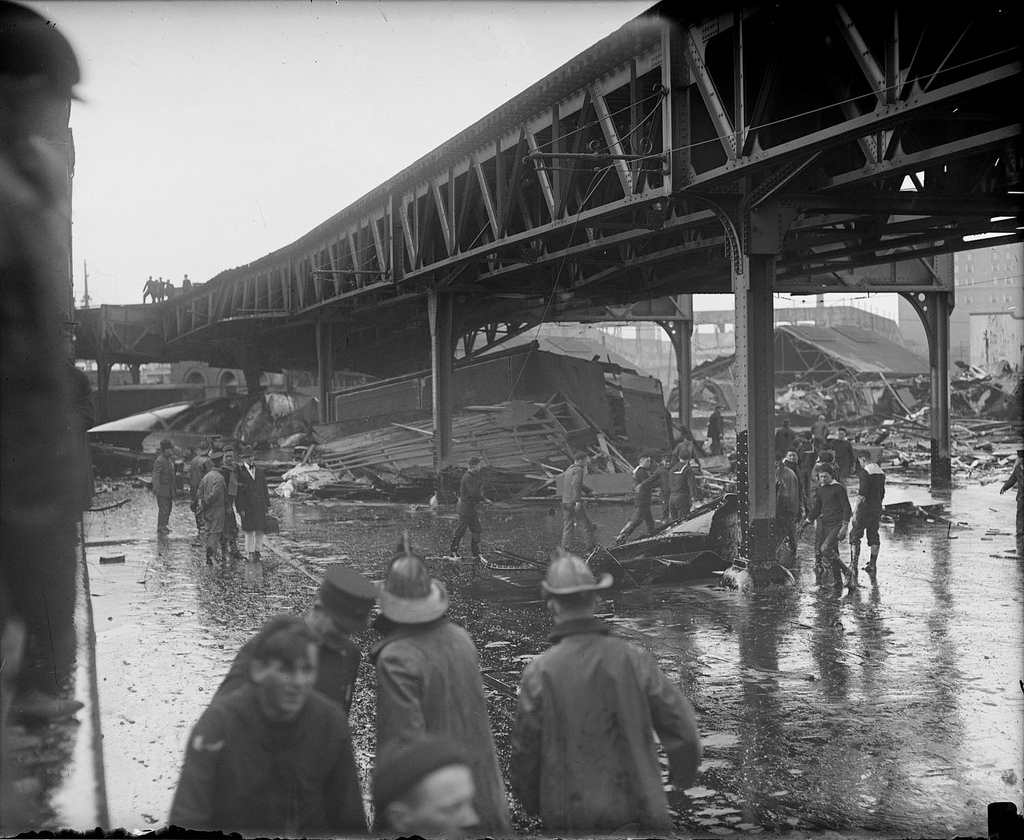
The two-and-a-half million gallon column of thick fluid collapsed instantly into the Boston streets. The smothering goo swept up and inundated bystanders, tossing and rolling men, women, and children on a wave of thick sludge. The migrating wave of brown syrup pushed buildings off their foundations and overturned wagons, carts, horses, and motorcars. It broke the girders of an elevated rail track, and tossed aside train cars. Within minutes, several blocks of Boston’s streets were buried in struggling victims, rubble of ruined buildings, a clutter of tumbled vehicles, and other assorted wreckage, all coated and mired in several feet of sweet, tacky goo.
Rescue efforts began at once, but most who ventured into the morass became mired themselves, and in need of their own rescuing. Terrified survivors ran away from the chaotic scene covered from head to toe in dark brown molasses. The USS Nantucket was anchored at the Playground Pier a few blocks away, and upon learning of the scope of the disaster, Lieutenant Commander H. J. Copeland sent over a hundred of his able-bodied sailors to lend assistance. Police officers, military personnel, and Red Cross nurses slogged through the knee-deep syrup all night long, searching for sticky victims.
In all, twenty-one lives were lost in the disaster—mostly due to crushing and asphyxiation–-and 150 injuries were reported. It is said that a lawyer for Purity arrived on the scene within hours and tried to pin the disaster on anarchist saboteurs, but despite this continued insistence, the company ultimately paid out about $1 million in settlements (equivalent to about $11 million today). The nearby harbor remained brown through the rest of the winter and spring, and it took over six months to clean the structures, automobiles, and cobblestone streets of the sticky mess. By coincidence, the 18th amendment of the US Constitution was ratified the day after the catastrophe, paving the way to the Prohibition.
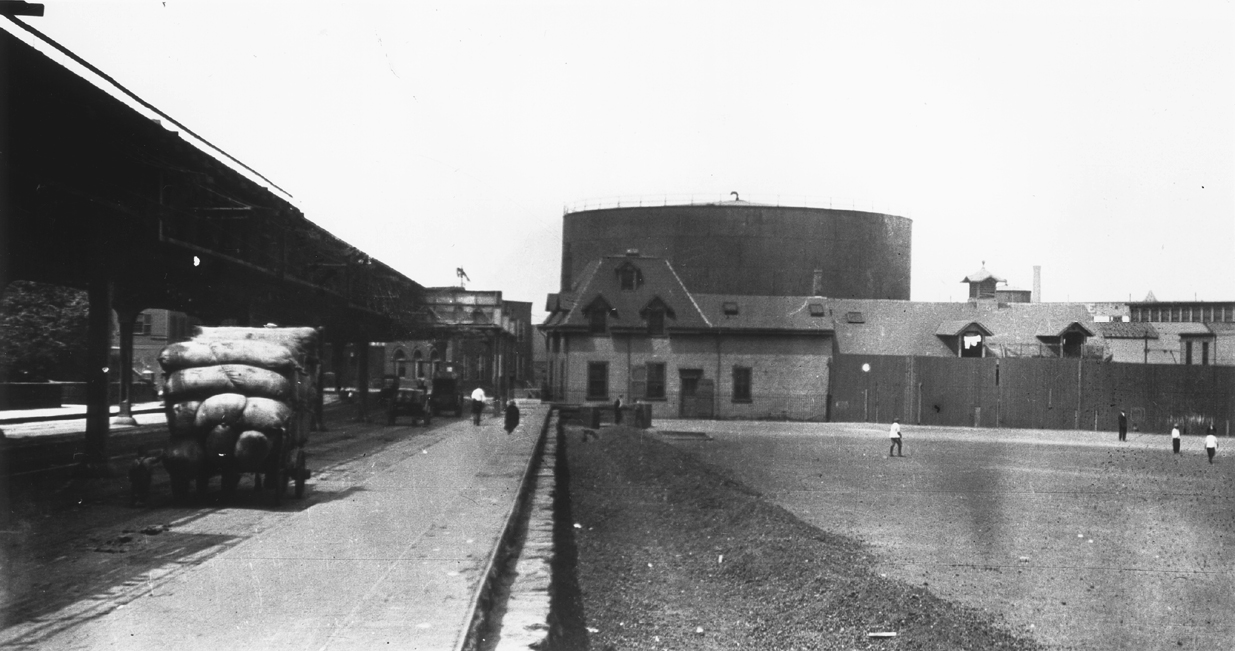
The exact cause of the explosion was never determined definitively, but it is generally attributed to high pressure and a defects in the tank construction. Witnesses testified that the Purity Distilling Company had neglected to pressure-test the massive vessel prior to filling it for the first time; and when it was first loaded with molasses, the outside of the tank became covered in brown rivulets from leaks. Rather than paying to reinforce and repair the inadequate tank, Purity had opted to paint the whole thing molasses brown. On warmer days the molasses would naturally ferment in the tank, increasing the internal pressure. Eventually the strain was more than the rivets could bear, and their failure ultimately resulted in the energetic rupture on that fateful day in 1919.
Although it’s been a century since the flood, they say that on a hot day the streets in some parts of Boston still bleed molasses.
© 2005 All Rights Reserved. Do not distribute or repurpose this work without written permission from the copyright holder(s).
Printed from https://www.damninteresting.com/the-great-molasses-flood-of-1919/
Since you enjoyed our work enough to print it out, and read it clear to the end, would you consider donating a few dollars at https://www.damninteresting.com/donate ?
That is one of the most bizarre and fascinating things that I have ever read.
Wow. I’m speechless!
There was a book published which describes these events in detail… it’s called Dark Tide: The Great Boston Molasses Flood of 1919 by Stephen Puleo. I haven’t read it myself, but it has some pretty good reviews on the Barnes and Noble and Amazon websites. Link
I can imagine the strays in Boston that weren’t outright killed by the flood livin high for the next few weeks…except the cats which have no sweet receptors on their tongues.
I remember seeing something on this on the History channel. I would to find a link to that video. Anyone have that perchance?
wow thats really interesting. what a way to die eh?
Sweet article…Very Damn interesting
I read the book. It was great. Kids would scrape up the molasses that leaked from the old tank to take home. Several were killed when it burst. A watchman for the company quit because he kept having dreams about it breaking shortly before it actually did! Good read.
Now WHERE exactly did the phrase “slow as molasses” come from?!?!?
kgy121 said: “Now WHERE exactly did the phrase “slow as molasses” come from?!?!?”
Obviously not from this incident, eh?
Thats because its “slow as molasses in January” and it must be a reference to something about people being slower then molasses in January. Or maybe just a boreal saying thats getting filtered down… I don’t know.
Enter your reply text here. Ok
What is their to comment on. It happened. Good story. Use it to ‘flirt’ while visiting the nusing home!
It’s not that molasses is not slow! They pumped in, through a 200 foot pipe, molasses from the ships which had just come up through the gulfstream Therefore, the molasses was still over 50 degrees…when it mixed with the 2 degree molasses in the tank, fermentation formed gas…I’m reading “Dark Tide”. Wow. Good book!
I ran I to this while helping my sons project book report. It’s interesting but a sad historical event.
Also known as The Boston Molassacre.
This is one of several example disasters presented in civil, mechanical, and structural engineering undergraduate programs. The Tacoma Narrows bridge failure (harmonics) and WWII North Sea Liberty Ship failures (brittle steel) are commonly taught as well. The mechanisms are different, but the point is the same … you mess up and people die as a result.
tsblue:
I agree.
However, people have also died when everything went right.
I am returned.
One year later already? Gad.